
Treatments · Radiofrequency & Nerve Ablation
Basivertebral Nerve Ablation (Intracept)
A minimally invasive procedure that ablates the basivertebral nerve inside the vertebral body, directly addressing vertebrogenic pain at its source rather than the disc or facet joints.
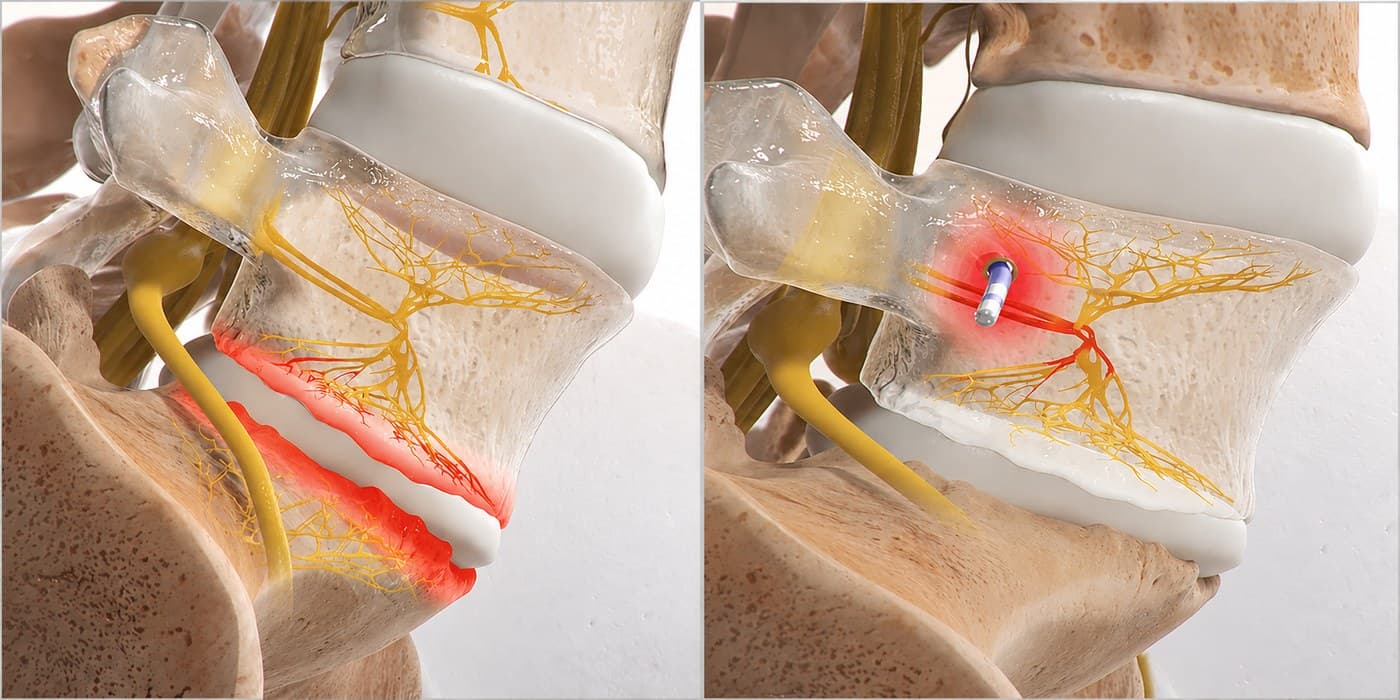
What it involves
The basivertebral nerve runs through the center of each vertebral body and carries pain signals from a damaged or inflamed vertebral endplate — the pain generator in vertebrogenic pain, confirmed by Modic type 1 or 2 changes on MRI. Under fluoroscopic guidance, a probe is introduced through the side of the vertebral body and directed to the basivertebral nerve's location near the center.
Radiofrequency energy is then delivered through the probe to ablate the nerve, disabling its ability to transmit the pain signal from the endplate — a single procedure per level, rather than a series of treatments.
How it works
Because the basivertebral nerve is the specific pathway carrying pain from the vertebral endplate, ablating it addresses vertebrogenic pain directly — distinct from treatments aimed at the disc or the facet joints, which are different pain generators entirely. Patient selection depends on confirming Modic changes at the level matching a patient's symptoms, since this procedure is only appropriate for that specific pain generator.
Unlike medial branch or peripheral nerve RFA, where treated nerves can regenerate and symptoms may eventually return, basivertebral nerve ablation tends to offer more durable relief without a need for repeat treatment in appropriately selected patients.
How We Build Your Plan
The clinical reasoning behind this recommendation
What's the diagnosis?
Chronic axial low back pain, typically present for six months or more, correlated with MRI showing Modic type 1 or 2 changes at the vertebral endplate matching the level of pain — a relatively specific imaging marker for this pain generator.
What's the mechanism?
Radiofrequency energy delivered to the basivertebral nerve, which runs through the center of the vertebral body, disables its ability to carry pain signals from a damaged or inflamed vertebral endplate.
What are the options?
Conservative care as a reasonable first step, though many patients have already tried extensive conservative treatment by the time vertebrogenic pain is specifically diagnosed; basivertebral nerve ablation for confirmed cases with matching Modic changes.
Why this approach?
Because Modic changes are a relatively specific marker for this particular pain generator, Dr. Foster reserves this procedure for patients whose imaging and symptom pattern clearly point to the vertebral endplate, rather than the disc or facet joints, as the source.
What are the tradeoffs?
This procedure directly addresses a confirmed pain generator and tends to offer durable relief without repeat treatment for well-selected patients, but appropriate candidacy — confirmed Modic changes and ruling out other pain generators — is what determines whether that benefit is realized.
What to Expect
An outpatient procedure with relief that builds over time
The ablation itself typically takes about 10 to 15 minutes per level treated, done on an outpatient basis under fluoroscopic guidance and anesthesia.
Most patients notice some soreness at the access site for a few days. Because the procedure addresses a nerve deep within the vertebral body, meaningful relief typically builds gradually over several weeks to a few months rather than appearing immediately, with improvement often continuing for up to a year in appropriately selected patients.
For more information about the Intracept procedure, visit the manufacturer's official resource: Intracept Procedure.
Chronic low back pain that hasn't responded to standard care?
An accurate diagnosis starts with a conversation. Reach out to schedule a consultation.