
Treatments · Soft Tissue & Regenerative Medicine
Tenex
An ultrasound-guided, minimally invasive procedure that removes damaged tendon tissue through a small incision — reserved for chronic tendinopathy that hasn't responded to conservative care.
What it involves
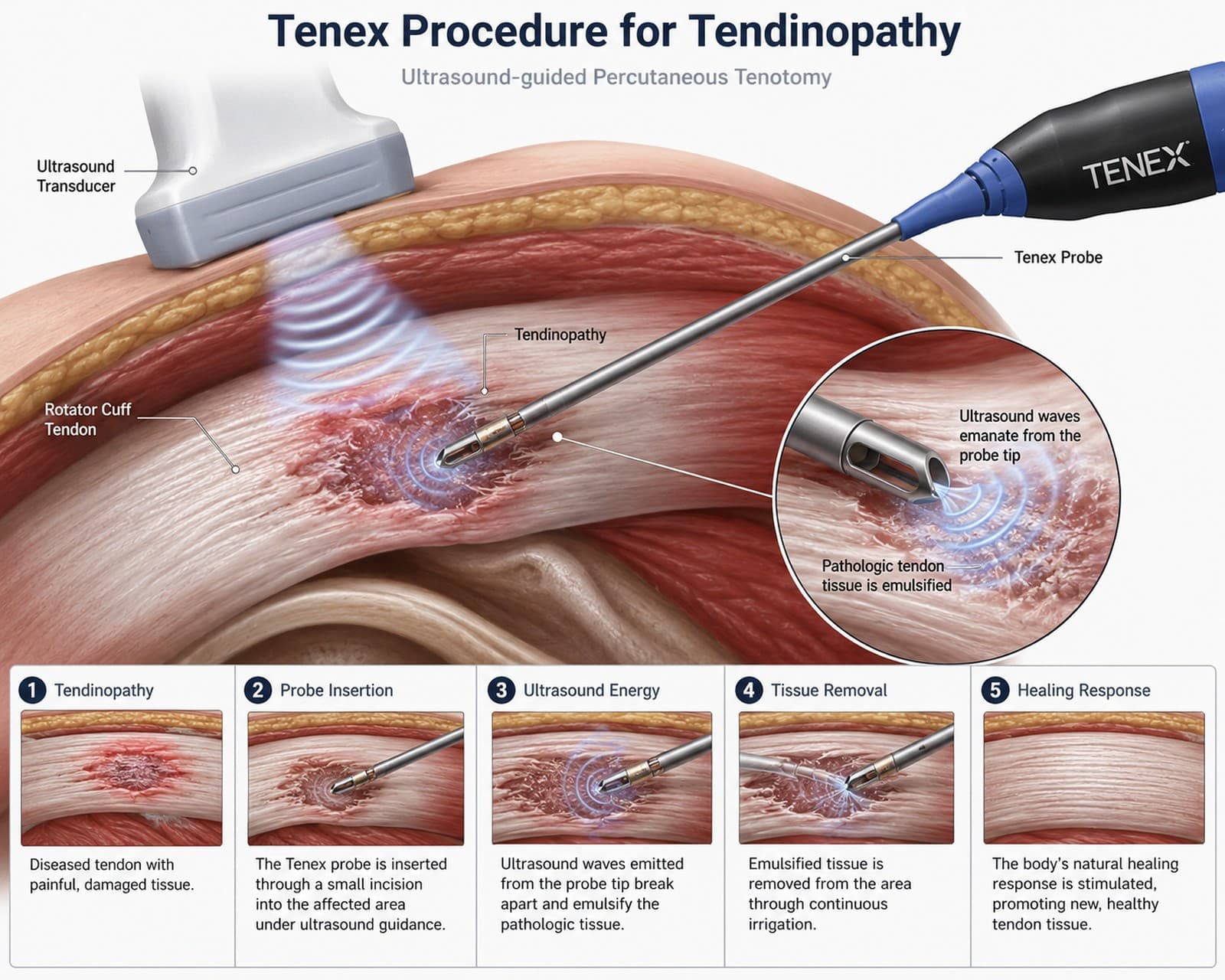
Chronic tendinopathy involves degenerated, disorganized tendon tissue that hasn't healed properly on its own. Under real-time ultrasound guidance, a small probe is introduced through a tiny incision — smaller than a standard IV needle — directly into the damaged portion of the tendon. The probe uses ultrasonic energy to break up and remove that damaged tissue while leaving healthy surrounding tendon intact.
Because the procedure is guided by real-time ultrasound imaging throughout, Dr. Foster can precisely target the specific damaged area identified on the pre-procedure workup, rather than treating the tendon broadly.
How it works
Removing chronically damaged tendon tissue triggers a fresh, localized healing response in its place — prompting the body to lay down new tissue rather than continuing to work around tissue that never fully recovered. This is reserved for chronic cases specifically, since the procedure's value depends on there being genuinely degenerated tissue to remove, not just an acute strain still in its normal healing window.
Tenex is generally considered after conservative care — eccentric loading exercise, activity modification — and often after PRP, for tendons that remain symptomatic despite that less invasive approach.
How We Build Your Plan
The clinical reasoning behind this recommendation
What's the diagnosis?
Chronic tendinopathy confirmed on ultrasound or MRI, showing structural tendon damage that has persisted despite an adequate trial of conservative care and, often, PRP.
What's the mechanism?
Ultrasonic energy delivered through a small probe breaks up and removes chronically degenerated tendon tissue, triggering a fresh localized healing response in its place rather than leaving the tendon to keep working around damaged tissue.
What are the options?
Activity modification and eccentric loading exercise as the foundation for nearly every patient, PRP for select cases with persistent symptoms, and Tenex for chronic, structurally damaged tendon tissue that hasn't responded to those less invasive options.
Why this approach?
Because Tenex physically removes damaged tissue rather than just calming symptoms, Dr. Foster reserves it for confirmed, chronic structural damage — a genuinely degenerated tendon, not simply a tendon that's still sore during its normal healing window.
What are the tradeoffs?
Tenex is minimally invasive with a relatively quick recovery compared to open tendon surgery, but it's still a procedure that removes tissue, so candidacy depends on confirmed structural damage rather than pain alone, and a period of activity modification afterward matters for the healing response to actually take hold.
What to Expect
A brief outpatient procedure with a staged recovery
The procedure itself typically takes about 20 to 30 minutes, done under local anesthesia on an outpatient basis. Because only a tiny incision is needed, stitches usually aren't required — just a small bandage.
Recovery is staged: activity is limited for the first couple of weeks to let the initial healing response begin, followed by a structured return to loading and eccentric exercise. Meaningful improvement typically builds over six to twelve weeks as the new tissue matures.
For more information about the Tenex procedure, visit the manufacturer's official resource: Tenex Health.
Dealing with chronic tendon pain that hasn't resolved?
An accurate diagnosis starts with a conversation. Reach out to schedule a consultation.