
Conditions · Joint & Structural
Tendinopathy
Tendinopathy is a chronic tendon overuse injury — common at the elbow (tennis elbow), Achilles, patellar, and rotator cuff tendons — that often persists despite rest and generic physical therapy, and responds best to a plan aimed at the tendon itself rather than the joint around it.
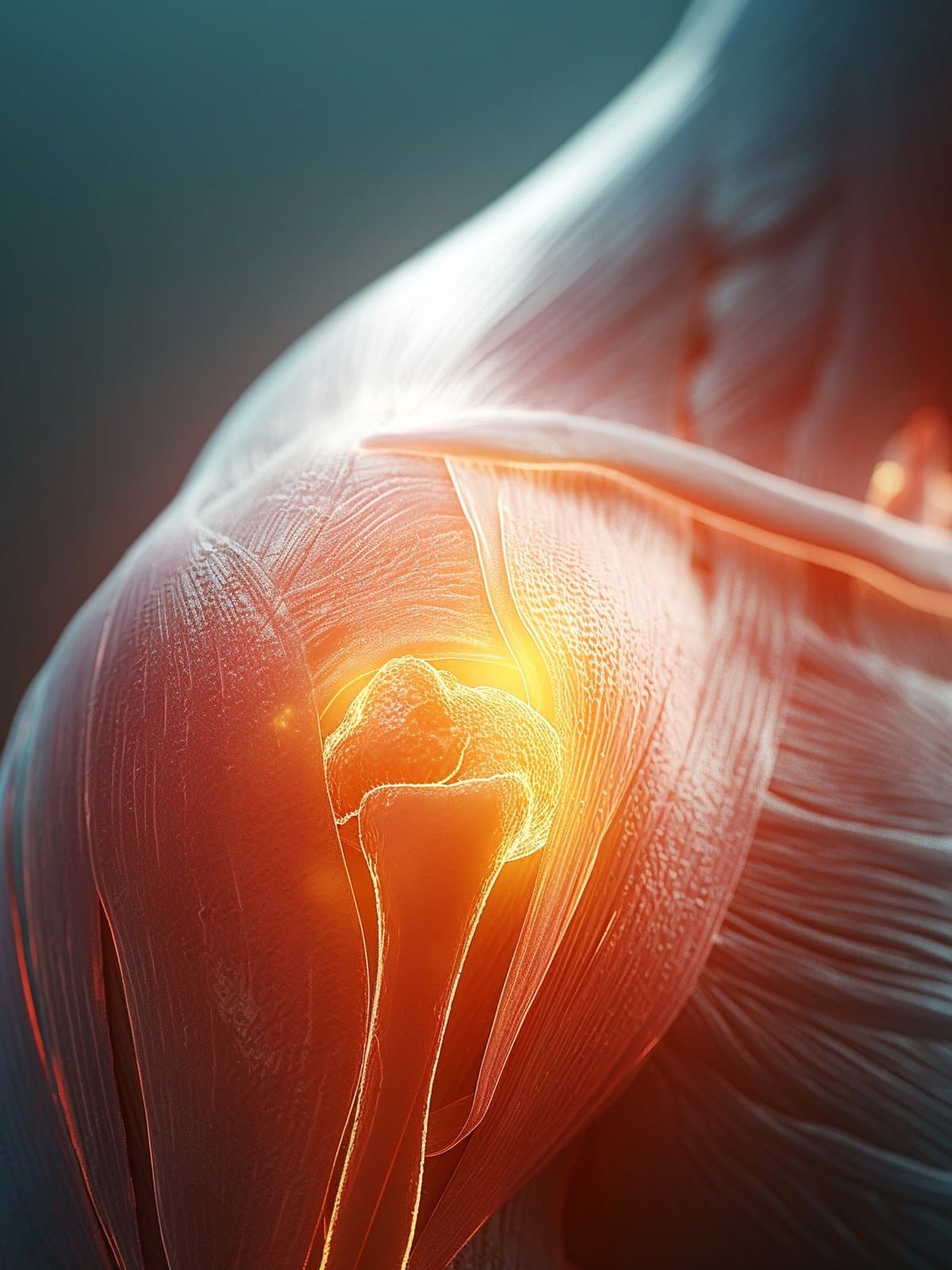
Understanding Tendinopathy
Tendinopathy develops when a tendon is repeatedly loaded beyond its capacity to recover — common at the lateral elbow (tennis elbow), the Achilles tendon, the patellar tendon below the kneecap, and the rotator cuff tendons of the shoulder. Despite the "-itis" in older terminology, chronic tendinopathy is primarily a degenerative process within the tendon's collagen structure, not a straightforward inflammatory one, which is a key reason it often doesn't respond well to rest and anti-inflammatories alone once it's become chronic.
Because the involved tendons sit right alongside joints, tendinopathy is frequently mistaken for — or coexists with — joint-based pain such as arthritis. Distinguishing the two matters: pain that's reproduced specifically with resisted tendon loading or direct tendon palpation, rather than with joint range of motion alone, points toward the tendon as the primary source.
Care Pathway
How treatment typically progresses
Start with Conservative Care
Activity Modification
Eccentric Loading & Physical Therapy
Medications
If Conservative Care Isn't Enough
Regenerative Treatment: Platelet-Rich Plasma (PRP)
Tenex
Surgical Referral (Orthopedic)
Tendinopathy generally responds best to a staged approach — building the tendon's capacity through targeted loading before considering a procedure — rather than jumping straight to an injection, Tenex, or surgery. Surgical referral sits at the end of that progression, reserved for structural tears or cases that genuinely need it, not as a default when earlier steps take time to work.
How We Build Your Plan
The clinical reasoning behind this recommendation
What's the diagnosis?
A history of activity-related pain localized to a specific tendon, reproduced with resisted loading or direct palpation of that tendon — distinguishing it from joint-based pain, which is typically provoked by range of motion instead.
What's the mechanism?
Repeated loading beyond the tendon's capacity to recover leads to a degenerative process within the tendon's collagen structure, not a simple inflammatory one — which is why treatments aimed purely at reducing inflammation often underperform once symptoms become chronic.
What are the options?
Activity modification and eccentric loading exercise as the foundation for nearly every patient, PRP for select cases with persistent symptoms despite adequate loading-based rehab, Tenex for chronic, structurally damaged tendon tissue that hasn't responded to less invasive care, and surgical referral for a confirmed structural tear or cases that genuinely don't resolve with the above.
Why this approach?
Because tendinopathy responds to structured loading in a way that true joint pathology doesn't, Dr. Foster prioritizes correctly identifying the tendon as the source and building a progressive loading program before considering a procedure aimed at the tendon tissue itself — while also recognizing early, through imaging and exam, when a structural tear means surgery is genuinely the right next step rather than something to work around.
What are the tradeoffs?
Eccentric loading programs require real patient commitment and take weeks to show benefit, but they address the underlying tendon capacity rather than just masking pain. PRP and Tenex offer more direct options for chronic, treatment-resistant cases, but neither replaces the loading program — they work best alongside continued rehabilitation, not instead of it. And for a genuine structural tear, no injection or minimally invasive procedure substitutes for surgical repair — recognizing that early spares patients time spent on options that were never going to resolve it.
Prognosis
Slower to resolve than an acute injury, but generally very treatable
Chronic tendinopathy typically takes longer to improve than an acute strain — often measured in months of consistent loading-based rehabilitation rather than weeks — because it's a structural remodeling process, not just symptom resolution. The good news is that with a properly staged approach, most patients see substantial improvement, and the toolkit for genuinely stubborn cases — PRP and Tenex — offers real options short of surgery for tendons that don't respond to loading programs alone. For the smaller subset with a confirmed structural tear, or tendinopathy that simply doesn't resolve with the full non-surgical pathway, a timely referral to orthopedic surgery is the right outcome, not a shortfall in the care that came before it.
Related Treatments
Treatment options for this condition
Sources & Further Reading⌄
- Khan KM, Cook JL, Bonar F, Harcourt P, Astrom M. "Histopathology of common tendinopathies. Update and implications for clinical management." Sports Med. 1999;27(6):393-408. This influential review established that chronic tendinopathy is primarily a degenerative process within the tendon (tendinosis) rather than a purely inflammatory one (tendinitis), which is why treatments aimed only at reducing inflammation often fall short for symptoms that have persisted beyond a few weeks. View source →
- Alfredson H, Pietilä T, Jonsson P, Lorentzon R. "Heavy-Load Eccentric Calf Muscle Training For the Treatment of Chronic Achilles Tendinosis." Am J Sports Med. 1998;26(3):360-366. This foundational study — and the substantial body of research it launched across other tendons, including the patellar tendon — established eccentric loading as an evidence-based approach for improving pain and function in chronic tendinopathy by promoting structured tendon remodeling. View source →
- Prudêncio DA, Maffulli N, Migliorini F, et al. "Eccentric exercise is more effective than other exercises in the treatment of mid-portion Achilles tendinopathy: systematic review and meta-analysis." BMC Sports Sci Med Rehabil. 2023;15:9. This recent systematic review and meta-analysis confirms eccentric exercise outperforms other exercise approaches for Achilles tendinopathy, reinforcing more than two decades later that the original approach remains the evidence-based standard. View source →
Think this might describe your pain?
An accurate diagnosis starts with a conversation. Reach out to schedule a consultation.