
Conditions · Joint & Structural
Facet Joint Syndrome
The facet joints are the small, paired joints at the back of each level of your spine that let you bend and twist. Like any joint in the body, they can develop osteoarthritis over time — producing a deep, localized ache that's often worse with standing, walking, or arching the back.
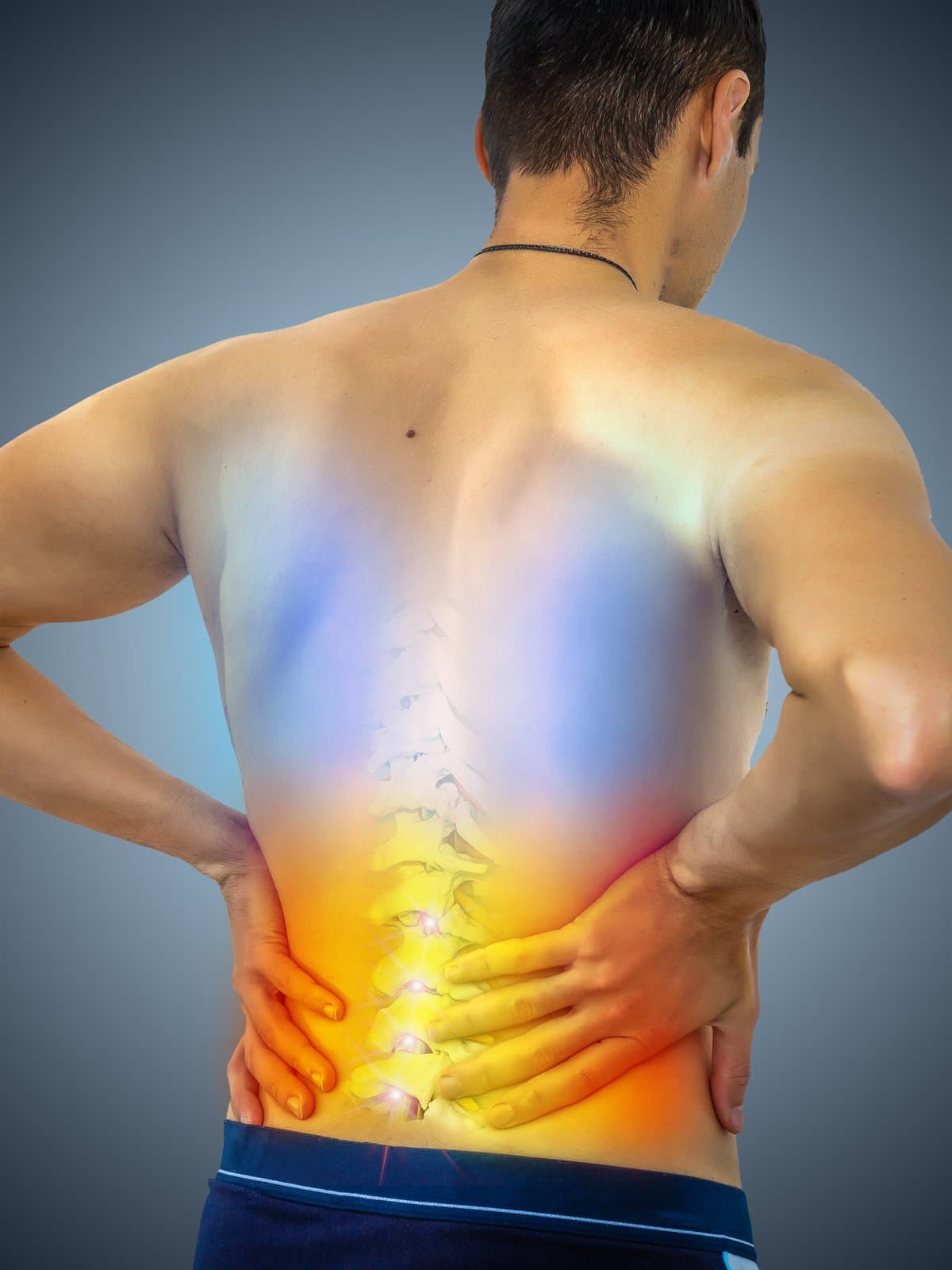
Understanding Facet Joint Syndrome
Every spinal level has a pair of facet joints that guide and limit motion. As the discs between vertebrae lose height with age or injury, more mechanical load gets shifted onto these joints, accelerating wear — much like how a misaligned knee eventually wears unevenly. The result is arthritis-like degeneration that can become a persistent source of pain.
Facet-related pain typically feels like a deep, localized ache near the spine that worsens with extension (arching backward) or rotation, and often eases when sitting or leaning forward — a pattern that can look similar to other causes of back pain but behaves differently on exam.
Care Pathway
How treatment typically progresses
Start with Conservative Care
Medications
Physical Therapy & Exercise
Activity & Behavior Modifications
If Conservative Care Isn't Enough
Diagnostic Medial Branch Block (MBB)
Radiofrequency Ablation (RFA)
Regenerative Treatment: Platelet-Rich Plasma (PRP)
Surgical Endoscopic Rhizotomy (Last Resort)
This is a logical progression based on your response to each step — not a jump straight to the most invasive option, and not a rigid ladder you have to climb regardless of your diagnosis.
How We Build Your Plan
The clinical reasoning behind this recommendation
What's the diagnosis?
A physical exam showing pain reproduced with spinal extension and rotation, correlated with imaging showing facet degeneration at the matching level — but confirmed only by a diagnostic medial branch block, not imaging alone.
What's the mechanism?
Facet joints are true synovial joints that can develop osteoarthritis. As discs degenerate and lose height, they transfer more load onto the facets, accelerating that wear and irritating the joint capsule and the small medial branch nerves that carry its pain signal.
What are the options?
Activity modification and targeted physical therapy, a diagnostic medial branch block, radiofrequency ablation (RFA) of the medial branches if the block is positive, regenerative treatment for select patients, and — rarely — surgical endoscopic rhizotomy, which Dr. Foster performs himself.
Why this approach?
Facet degeneration shows up on imaging in plenty of people with no back pain at all, so a scan showing arthritis doesn't prove it's the cause of your symptoms. The medial branch block is what actually tests whether that specific joint is generating your pain — and it's the same diagnostic step that determines candidacy for RFA.
What are the tradeoffs?
Radiofrequency ablation provides substantial, often long-lasting relief, but it isn't a permanent fix — it interrupts the pain signal rather than reversing the arthritis, and relief typically fades as the treated nerves regenerate, at which point the procedure can be repeated.
Prognosis
A condition to manage well, not one that disappears
Facet joint syndrome comes from arthritis-like degeneration in the joint itself, and that underlying wear doesn't reverse — so this is generally a chronic, long-term condition rather than one with a defined cure. The good news is that the pain itself responds very well to treatment: most patients get substantial, repeatable relief from radiofrequency ablation, often maintaining good function for years with simple periodic retreatment rather than an escalating series of procedures, and surgery is rarely needed. It's a condition most patients end up managing quite comfortably over the long run.
Related Treatments
Treatment options for this condition
Sources & Further Reading⌄
- Qaseem A, Wilt TJ, McLean RM, Forciea MA. "Noninvasive Treatments for Acute, Subacute, and Chronic Low Back Pain: A Clinical Practice Guideline From the American College of Physicians." Ann Intern Med. 2017;166(7):514-530. This guideline recommends exercise-based and non-pharmacologic therapy as first-line treatment for most causes of mechanical back pain before considering invasive options. View source →
- Schmidt H, Reitmaier S, Yang D, Duda G, Pumberger M. "Degenerative relationships in lumbar intervertebral discs and facet joints: an MRI-based comparative study of asymptomatic individuals and patients with chronic and intermittent low back pain." Front Bioeng Biotechnol. 2025. Comparing 254 asymptomatic individuals against 458 patients with low back pain, this study found only a weak correlation between facet joint degeneration on imaging and clinical symptoms, which is why facet changes seen on CT or MRI alone cannot confirm the facet joint as the actual source of a patient's pain. View source →
- Láinez Ramos-Bossini AJ, Jiménez Gutiérrez PM, Ruiz Santiago F. "Efficacy of radiofrequency in lumbar facet joint pain: a systematic review and meta-analysis of placebo-controlled randomized controlled trials." Radiol Med. 2024;129(5):794-806. This meta-analysis of 8 placebo-controlled RCTs (472 patients) confirms medial branch block followed by radiofrequency ablation is a well-supported approach for confirmed facet-mediated pain, with significant pain and function benefit over placebo in the short, medium, and long term. View source →
- Radiofrequency ablation relief commonly lasts roughly 9 to 18 months as the treated nerves gradually regenerate — a range drawn from broad clinical experience and published case series across the field, rather than one single study, since reported durations vary depending on the joint treated and technique used.
- Manchikanti L, Abd-Elsayed A, Kaye AD, Sanapati MR, Pampati V, Shekoohi S, Hirsch JA. "A Systematic Review of Regenerative Medicine Therapies for Axial Spine Pain of Facet Joint Origin." Curr Pain Headache Rep. 2025. This systematic review grades PRP evidence for facet joint pain as Level II/moderate — still emerging and less robust than the evidence supporting medial branch block and radiofrequency ablation. View source →
Think this might describe your pain?
An accurate diagnosis starts with a conversation. Reach out to schedule a consultation.