
Conditions · Joint & Structural
Vertebral Compression Fractures
A vertebral compression fracture happens when a vertebral body collapses under normal loading forces, most often because osteoporosis has weakened the bone. The result is sudden, often severe back pain — and, over time, progressive loss of height and posture if fractures accumulate.
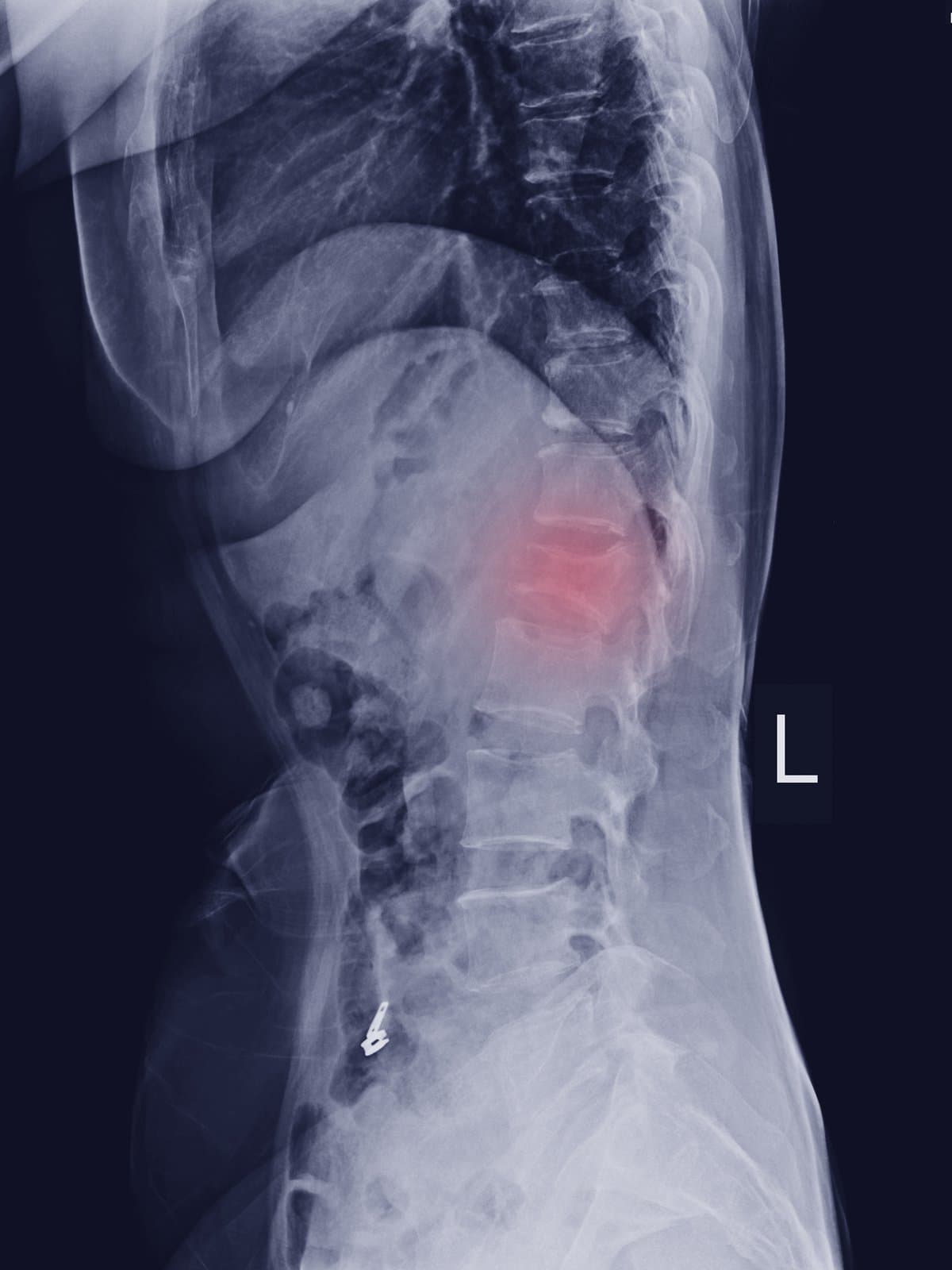
Understanding Vertebral Compression Fractures
The vertebral body is normally strong enough to bear the load of everyday movement. When osteoporosis thins that bone — or less commonly, trauma or a tumor weakens it — the vertebral body can collapse under forces it would ordinarily handle without issue. This produces sudden, sharp back pain that's typically worse sitting or standing upright and eased by lying down.
A single fracture is a warning sign, not just an isolated event: once one vertebra fractures, the altered mechanics and underlying bone fragility raise the risk of another fracture at a nearby level. Multiple fractures over time can lead to a progressive forward curve of the spine (kyphosis) and loss of height.
Care Pathway
How treatment typically progresses
Start with Conservative Care
Medications
Physical Therapy & Exercise
Activity & Behavior Modifications
If Conservative Care Isn't Enough
Kyphoplasty
SpineJack
Sacroplasty
Not every compression fracture needs augmentation — many heal well with conservative care alone. But for fractures causing significant, persistent pain, augmentation offers something unusual: a fast, substantial fix rather than a prolonged recovery.
How We Build Your Plan
The clinical reasoning behind this recommendation
What's the diagnosis?
Correlating the onset and location of pain with imaging — an MRI showing bone marrow edema is what confirms a fracture is acute and likely the source of current pain, distinguishing it from an old, already-healed fracture.
What's the mechanism?
The vertebral body loses structural integrity, most often from osteoporotic bone weakening, and collapses under normal loading forces. That collapse causes pain both from the fracture itself and from the altered mechanics it creates in the surrounding spine.
What are the options?
Bracing, pain management, and osteoporosis treatment for fractures expected to heal on their own; vertebral augmentation (kyphoplasty or SpineJack) for painful vertebral body fractures; sacroplasty specifically for sacral insufficiency fractures.
Why this approach?
An MRI confirming an acute, edematous fracture — not an old, already-stable one — is what determines whether augmentation is likely to help, since the procedure stabilizes the specific fracture responsible for your current pain.
What are the tradeoffs?
Augmentation offers fast, often dramatic relief and helps prevent further height loss, but it isn't the right fit for every fracture — many heal well with conservative management alone — and it doesn't address the underlying osteoporosis driving future fracture risk, which requires separate, ongoing medical management.
Prognosis
Often a fast, genuine fix — but not every fracture needs one
Many acute compression fractures heal on their own over roughly 6 to 8 weeks with conservative care, and pain gradually improves as the fracture stabilizes. But for fractures causing significant, persistent pain, vertebral augmentation is unusual among orthopedic procedures in offering fast, often same-day, substantial relief — it doesn't just manage the pain, it stabilizes the actual structural problem causing it. The larger long-term issue is the underlying osteoporosis: without addressing that separately, the risk of another fracture at a different level remains real, which is why bone health management matters alongside any procedure.
Related Treatments
Treatment options for this condition
Sources & Further Reading⌄
- North American Spine Society. "Evidence-Based Clinical Guideline for the Diagnosis and Treatment of Adults with Osteoporotic Vertebral Compression Fractures." Approved by the NASS Board of Directors, reflecting literature through September 2020. This current guideline supports conservative care as a reasonable first approach for neurologically intact patients without severe or progressive symptoms, with many acute fractures improving within 6 to 8 weeks. View source →
- Encalada S, Hunt C, Duszynski B, et al. "The effectiveness of balloon kyphoplasty compared to conservative treatment for osteoporotic vertebral compression fractures: A systematic review and meta-analysis." Interv Pain Med. 2025;4(1). This current meta-analysis of the full evidence base — including the landmark FREE trial — found balloon kyphoplasty produces superior pain reduction over conservative care from 1 to 12 months for appropriately selected patients with acute, painful compression fractures. View source →
- Singh M, Balmaceno-Criss M, Knebel A, et al. "Sacroplasty for Sacral Insufficiency Fractures: Narrative Literature Review on Patient Selection, Technical Approaches, and Outcomes." J Clin Med. 2024;13(4):1101. This current review documents a growing base of supportive evidence applying the same cement augmentation principle used for vertebral body fractures to the anatomically distinct sacrum. View source →
Think this might describe your pain?
An accurate diagnosis starts with a conversation. Reach out to schedule a consultation.