
Treatments · Vertebral Augmentation
Kyphoplasty
A minimally invasive procedure that stabilizes a fractured vertebra and restores lost height using a balloon and bone cement — often providing rapid, meaningful pain relief after a compression fracture.
What it involves
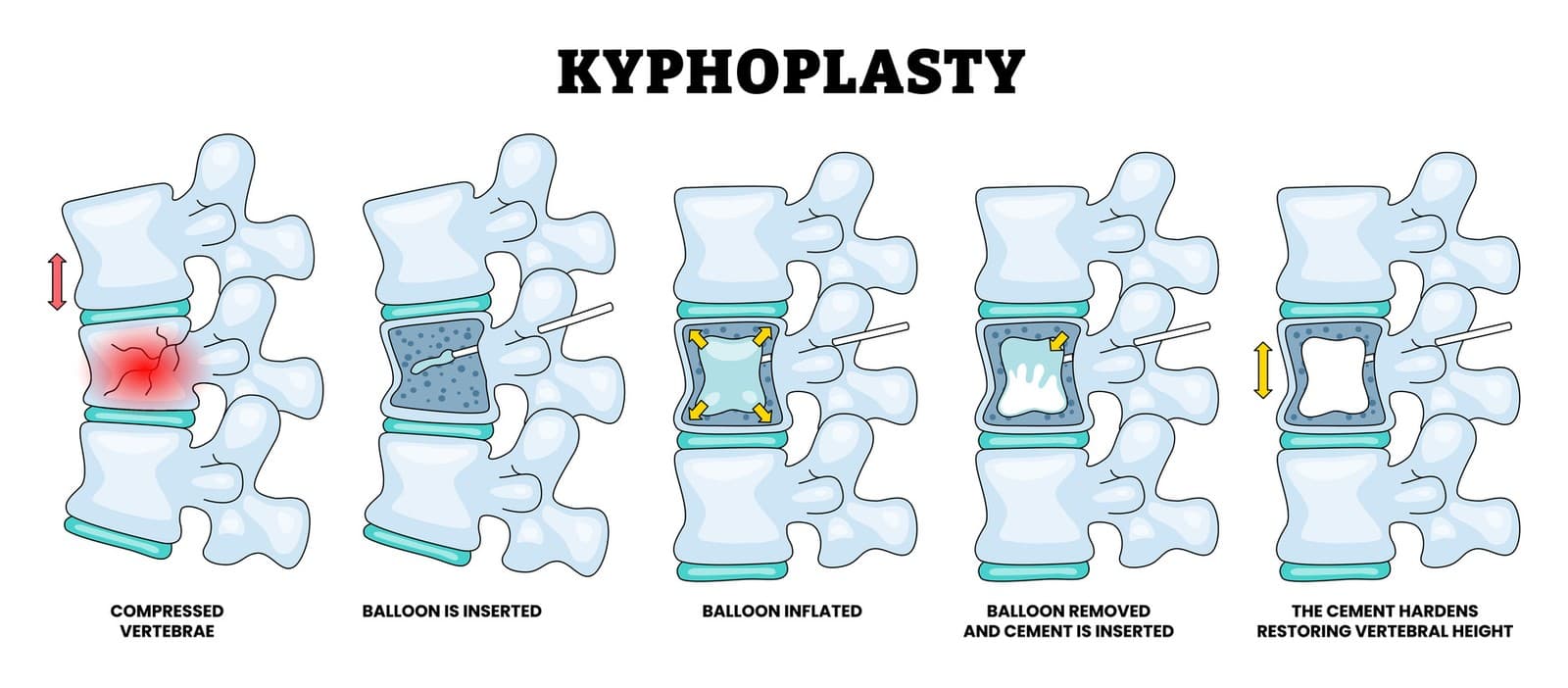
Kyphoplasty treats a vertebral compression fracture — most often from osteoporosis or trauma — by restoring some of the height lost when the vertebral body collapsed, and then stabilizing it. Under fluoroscopic guidance, a small cannula is placed into the fractured vertebral body, and a balloon is inflated to create a cavity and lift the collapsed bone back toward its original height.
The balloon is then deflated and withdrawn, and the cavity it created is filled with bone cement, which hardens within minutes to stabilize the vertebra and eliminate the abnormal micromotion at the fracture site that drives much of the pain. Outcomes tend to be best when the procedure is done within about 4 weeks of the fracture, before the vertebral body has had a chance to heal in a collapsed position. Medicare coverage criteria reflect this same timing principle, distinguishing an acute window (under 6 weeks) from a subacute one (6 to 12 weeks) when determining eligibility.
Related options
Two related procedures use the same cement-augmentation principle for different situations. When a patient may benefit from a mechanical, implant-assisted approach to height restoration rather than a balloon alone, SpineJack uses a small titanium implant to restore vertebral height before cement is added. And when the fracture is in the sacrum rather than the vertebral body, sacroplasty applies the same stabilizing cement principle specifically to sacral insufficiency fractures.
How We Build Your Plan
The clinical reasoning behind this recommendation
What's the diagnosis?
Sudden or worsening back pain, correlated with MRI or CT confirming an acute or subacute vertebral compression fracture — most often in the setting of osteoporosis or trauma.
What's the mechanism?
Restoring height to the collapsed vertebra and stabilizing it with cement eliminates the abnormal motion at the fracture site that's driving pain, while also helping to limit further height loss and the progressive kyphotic (forward-stooped) posture that untreated fractures can cause over time.
What are the options?
Kyphoplasty (balloon-assisted), SpineJack (mechanical, implant-assisted height restoration), or vertebroplasty (cement without height restoration) depending on the fracture pattern, timing, and how much height loss has already occurred.
Why this approach?
For fractures where restoring height is still achievable — generally when treated within the acute-to-subacute window after the fracture occurs — Dr. Foster favors kyphoplasty or SpineJack over plain vertebroplasty, since restoring vertebral height and posture has functional benefits beyond pain relief alone.
What are the tradeoffs?
Kyphoplasty typically provides rapid, often dramatic pain relief, but it's a structural procedure — not appropriate for old, already-healed fractures. Cement leakage and adjacent-level fracture are recognized, low-frequency risks that factor into patient selection and technique.
What to Expect
Often rapid relief, with a short recovery
Kyphoplasty is typically done as an outpatient or short-stay procedure under sedation or light anesthesia, taking roughly 30 to 60 minutes per level treated. Many patients notice significant pain relief within a day of the procedure — a faster response than most other options in the care pathway.
Walking is generally encouraged soon after the procedure, and a back brace is sometimes used temporarily for additional support. Most patients return to normal daily activity within days to a couple of weeks, depending on overall health and bone density.
Conditions This Treats
Conditions this treatment addresses
Sources & Further Reading⌄
- Khan MA, Kisana H, Clay C, et al. "The effect of time to balloon kyphoplasty on osteoporotic vertebral compression fractures: a systematic review with meta-analysis." N Am Spine Soc J. 2024;21:100576. This recent meta-analysis found treatment within 4 weeks produces significantly better pain scores and kyphotic angle correction than later treatment, reinforcing that outcomes with kyphoplasty and other cement-augmentation procedures tend to be best when performed within the acute-to-subacute window after a fracture, before the vertebral body has had a chance to heal in a collapsed position. View source →
- Centers for Medicare & Medicaid Services, Local Coverage Determination L34228, "Percutaneous Vertebral Augmentation (PVA) for Osteoporotic Vertebral Compression Fracture (VCF)." Medicare coverage criteria distinguish an acute window (fracture onset under 6 weeks) from a subacute window (6 to 12 weeks), reflecting the same clinical principle that earlier treatment is favored — worth confirming against your specific Medicare Administrative Contractor's current LCD, since criteria can vary and are periodically updated. View source →
For more information about kyphoplasty, visit the manufacturer's official resource: Stryker Interventional Spine.
Recently diagnosed with a compression fracture?
Timing matters with this procedure. Reach out to schedule a consultation.