
Treatments · Neuromodulation
Dorsal Root Ganglion (DRG) Stimulation
A targeted form of neuromodulation directed at the dorsal root ganglion — particularly effective for focal, well-localized pain such as CRPS or neuropathic pain affecting the foot, knee, or groin.
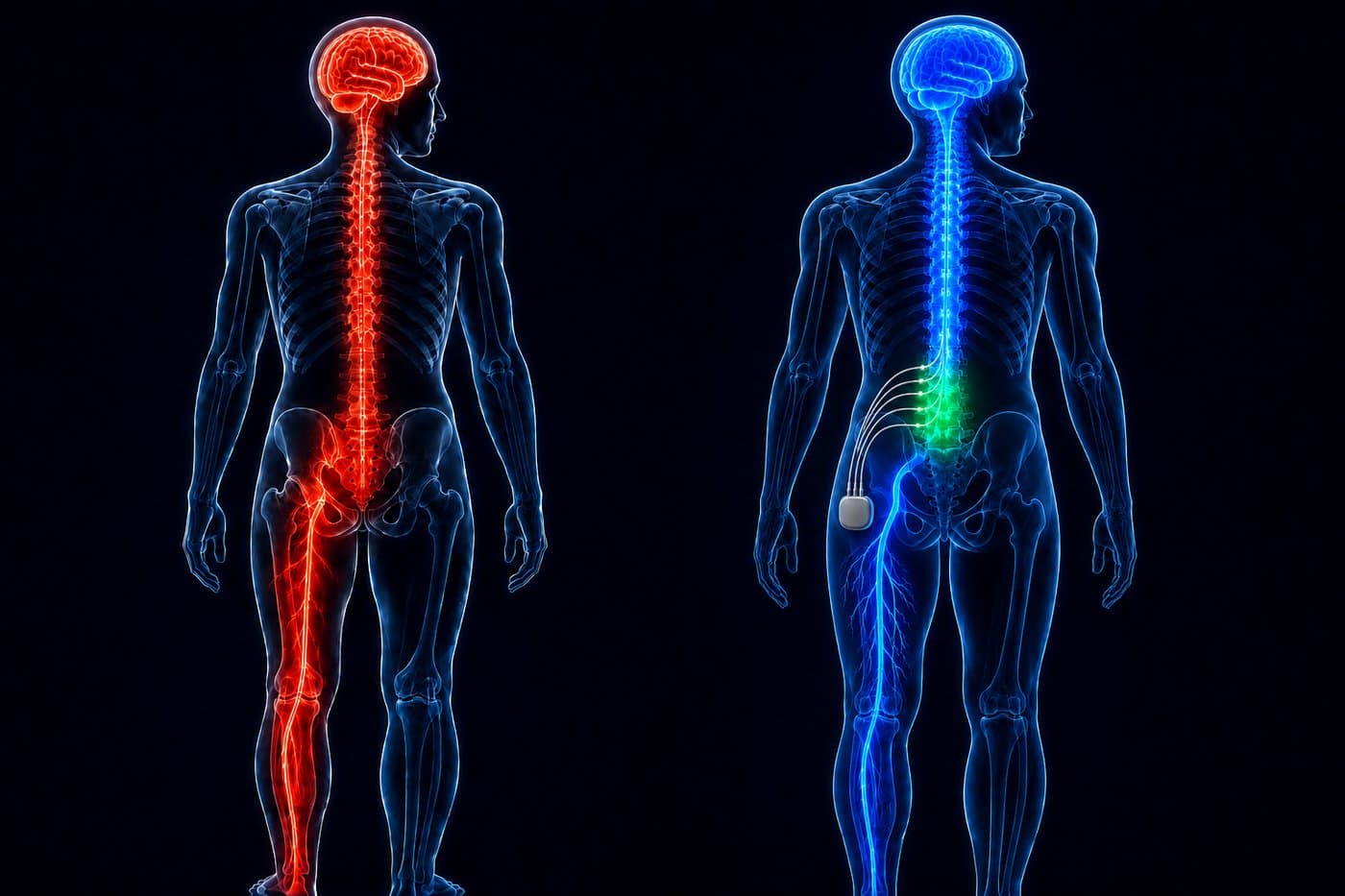
What it involves
The dorsal root ganglion (DRG) is a cluster of nerve cell bodies just outside the spinal cord, where sensory signals from a specific body region converge before entering the spinal cord itself. DRG stimulation places a small lead directly next to the DRG serving the affected area, delivering mild electrical stimulation to modulate abnormal pain signaling at that precise relay point.
As with other neuromodulation options, treatment starts with a trial: temporary leads are placed for roughly five to seven days so the patient and Dr. Foster can evaluate how much relief the stimulation actually provides before committing to a permanent implant.
How it works
Because the DRG corresponds to a specific, well-defined body region, stimulation targeted there offers more anatomical precision than traditional spinal cord stimulation, which covers a broader area. This focal precision is why DRG stimulation tends to work particularly well for pain confined to a single limb or a specific joint, such as CRPS affecting the foot, knee, or groin.
If the trial shows meaningful, reliable pain reduction, the leads and a small implanted pulse generator are placed in a short outpatient surgical procedure. The device is adjustable and reversible — settings can be tuned over time, and the system can be removed if it's no longer needed or effective.
How We Build Your Plan
The clinical reasoning behind this recommendation
What's the diagnosis?
Confirmed focal neuropathic pain or CRPS affecting a specific, well-localized area — commonly the foot, knee, or groin — that hasn't responded adequately to more conservative interventional options.
What's the mechanism?
Electrical stimulation delivered directly to the dorsal root ganglion — the relay point where sensory signals from a specific body region converge before entering the spinal cord — modulates abnormal pain signaling with more anatomical precision than traditional spinal cord stimulation.
What are the options?
Spinal cord stimulation offers broader coverage across a region, while DRG stimulation offers more precise, focal coverage — the choice depends on how localized the pain pattern is and which body area is affected.
Why this approach?
For CRPS or neuropathic pain confined to a specific limb or joint, Dr. Foster favors DRG stimulation's focal precision, since it tends to provide more consistent, targeted coverage than a broader spinal cord stimulator for these presentations.
What are the tradeoffs?
Like other neuromodulation options, DRG stimulation requires a trial period before permanent implantation and is a bigger step than an injection — but for the right focal presentation, it can offer more consistent, targeted relief than spinal cord stimulation.
What to Expect
A trial period first, then a reversible implant
The trial phase lasts about five to seven days with a temporary external device, during which Dr. Foster and the patient track how much the pain actually improves in daily life — not just in the office. A clear, meaningful reduction in pain during the trial is what determines candidacy for the permanent system.
Permanent implantation is a short, outpatient or short-stay surgical procedure, with recovery typically measured in a few weeks. Because the system is programmable and reversible, settings can be adjusted after implantation, and the device can ultimately be removed if needed.
Conditions This Treats
Conditions this treatment addresses
Sources & Further Reading⌄
- Deer TR, et al. "Dorsal root ganglion stimulation yielded higher treatment success rate for complex regional pain syndrome and causalgia at 3 and 12 months: a randomized comparative trial." Pain. 2017;158(4):669-681 (the ACCURATE trial). This RCT supports dorsal root ganglion stimulation for focal neuropathic pain and CRPS, with particular benefit demonstrated for presentations affecting a single limb or a well-localized region such as the foot, knee, or groin. View source →
For more information about DRG stimulation, visit the manufacturer's official resource: Abbott Proclaim DRG.
Dealing with focal nerve pain that hasn't responded to other treatment?
An accurate diagnosis starts with a conversation. Reach out to schedule a consultation.