
Treatments · Minimally Invasive Spine Procedures
Sacroiliac Joint (SI Joint) Fusion
A minimally invasive procedure to stabilize a painful, dysfunctional sacroiliac joint using small implants placed across the joint — reserved for patients who have failed conservative and injection-based care.
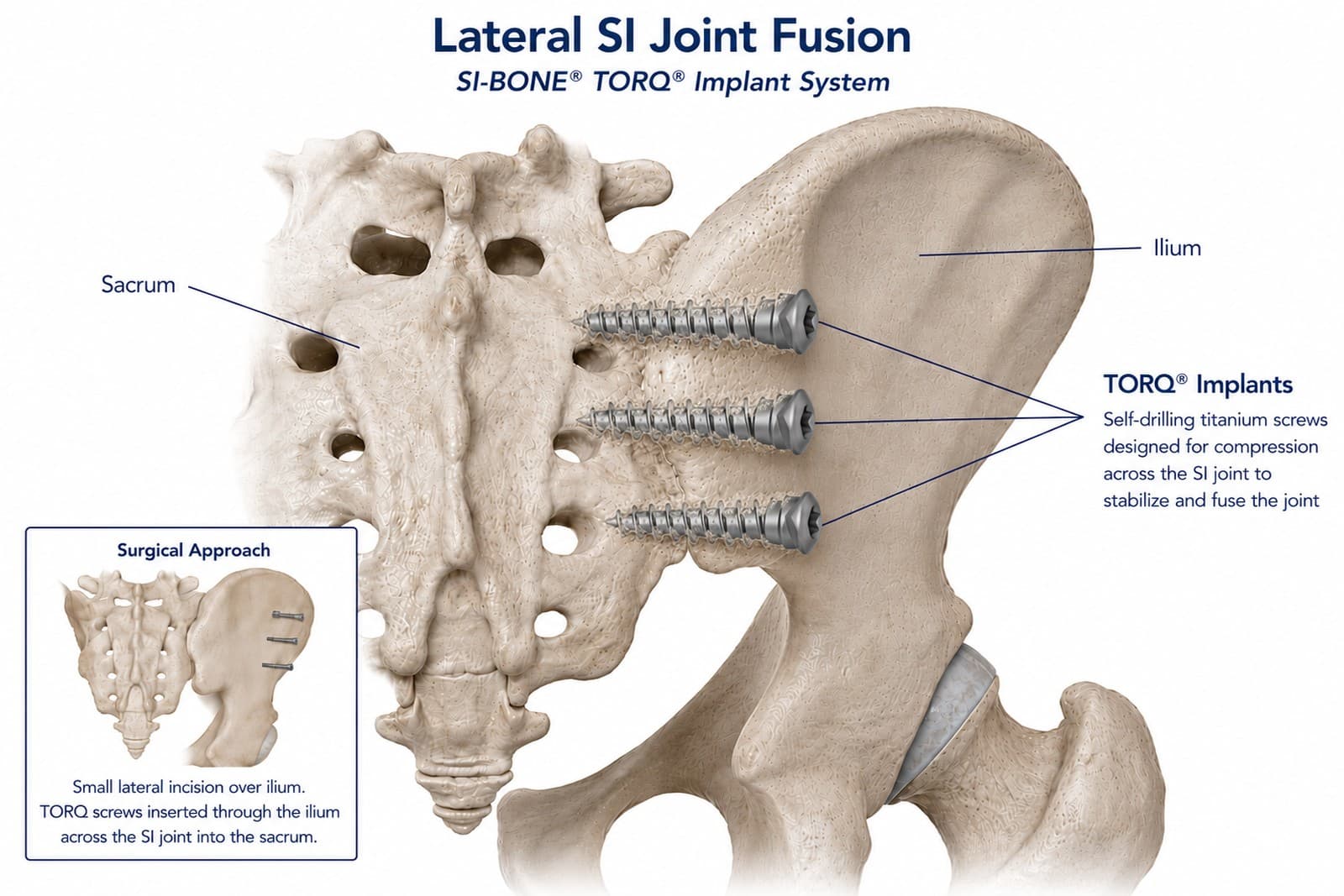
What it involves
Through a small incision, typically over the buttock, Dr. Foster places several small titanium implants across the SI joint under fluoroscopic guidance, stabilizing it directly rather than continuing to manage the pain of an unstable or degenerated joint with injections alone. This is a targeted, minimally invasive alternative to older, more invasive open fusion techniques.
Candidacy depends on the joint already being clearly confirmed as the pain generator — typically through a positive response to diagnostic SI joint injections — and having exhausted conservative and injection-based options without lasting relief.
How it works
The SI joint is normally built to allow only a small amount of motion; when it moves too much or has degenerated significantly, that abnormal motion itself becomes a source of pain that injections can calm temporarily but not permanently resolve. Fusion eliminates that motion directly, offering durable stabilization rather than repeat, time-limited treatments.
Current multi-society guidelines support fusion specifically for patients with confirmed SI joint pain who haven't gotten lasting relief from conservative and injection-based care, positioning it as a later, more definitive step rather than an early option.
How We Build Your Plan
The clinical reasoning behind this recommendation
What's the diagnosis?
A confirmed, structurally dysfunctional SI joint — established through a positive response to diagnostic SI joint injections — in a patient who hasn't gotten lasting relief from conservative care, injections, or radiofrequency ablation.
What's the mechanism?
Small implants placed across the SI joint eliminate the abnormal motion — too much, too little, or degenerated — that's generating pain, offering durable mechanical stabilization rather than temporarily calming the joint with medication.
What are the options?
Conservative care, diagnostic and therapeutic SI joint injections, and radiofrequency ablation are the earlier steps; fusion is considered once the joint is clearly confirmed as the pain source and those less invasive options haven't provided lasting relief.
Why this approach?
Because fusion is a more permanent, structural step than an injection or ablation, Dr. Foster reserves it for patients where the joint has been clearly and repeatedly confirmed as the pain generator — not simply suspected — and where less invasive options have already been given a fair trial.
What are the tradeoffs?
Fusion offers durable stabilization that injections and ablation can't match, but it's a surgical procedure with a real recovery period, appropriate only once the diagnosis is genuinely well-established and less invasive options have been exhausted.
What to Expect
A minimally invasive procedure with a structured recovery
The procedure typically takes about an hour and is often done on an outpatient or short-stay basis through a small incision, with recovery meaningfully shorter than older, open fusion techniques.
Activity is generally restricted for a period after surgery to allow the joint to stabilize and the implants to integrate, with a structured, gradual return to normal activity over the following weeks to months. Most patients who are good candidates see substantial, lasting improvement in joint stability and pain.
Conditions This Treats
Conditions this treatment addresses
Sources & Further Reading⌄
- Sayed D, Deer TR, Tieppo Francio V, et al. "American Society of Pain and Neuroscience Best Practice (ASPN) Guideline for the Treatment of Sacroiliac Disorders." J Pain Res. 2024;17:1601-1638. This current multi-society guideline covers the full SI joint care pathway, including patient selection criteria for surgical fusion once conservative and injection-based care hasn't provided lasting relief. View source →
For more information about SI joint fusion, visit the manufacturer's official resource: SI-BONE.
Haven't gotten lasting relief from SI joint injections?
An accurate diagnosis starts with a conversation. Reach out to schedule a consultation.