
Conditions · Joint & Structural
Sacroiliac Joint (SI Joint) Dysfunction
The sacroiliac joint — often shortened to "SI joint" — is where the base of the spine meets the pelvis. There's one on each side, and problems there are one of the most frequently overlooked causes of low back and buttock pain — often mistaken for a lumbar disc or nerve problem because the pain patterns overlap so closely.
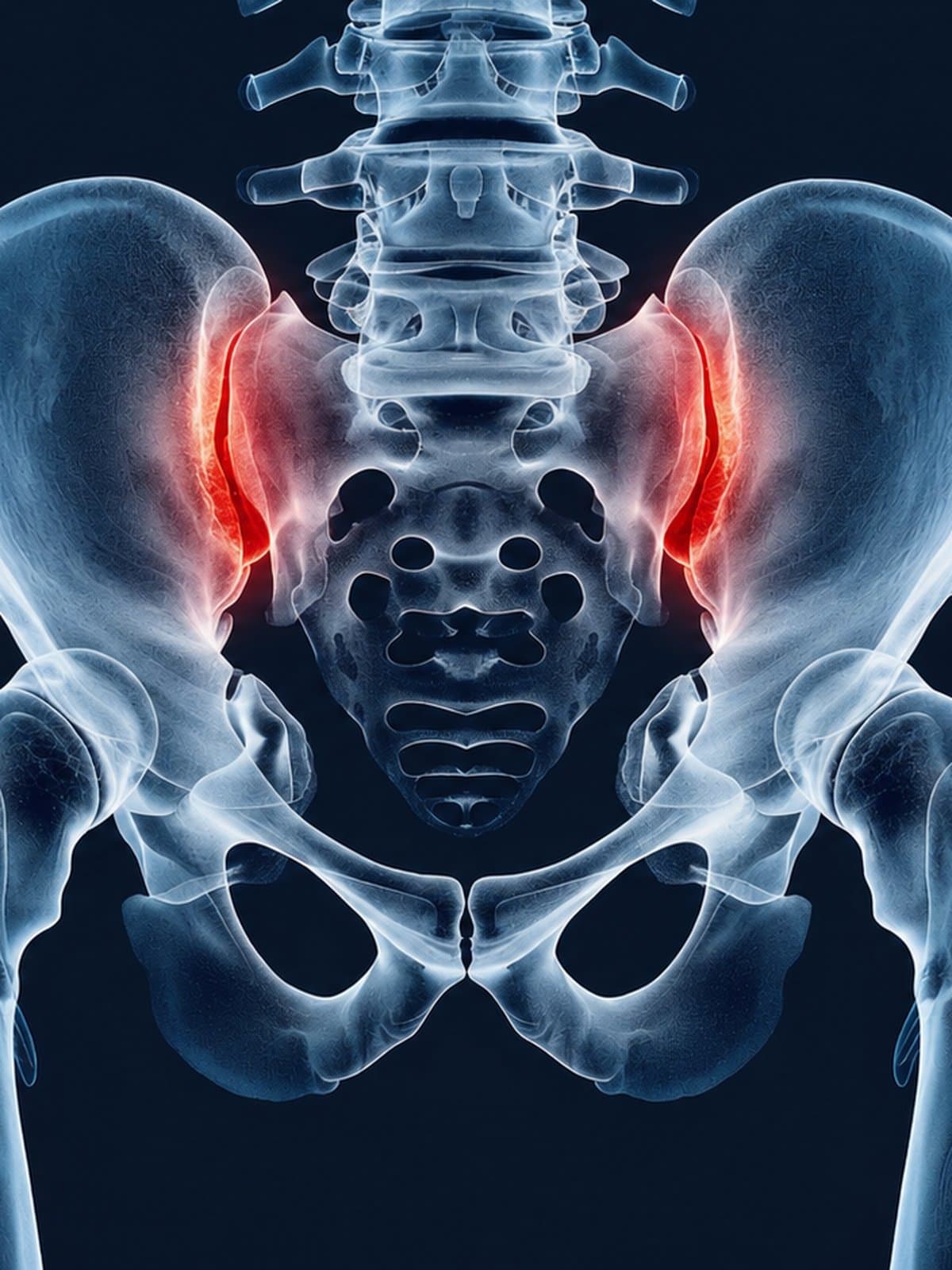
Understanding Sacroiliac Joint (SI Joint) Dysfunction
The SI joints carry the weight of your upper body into your legs with every step, and they're built to allow only a small amount of motion. When one joint moves too much, too little, or becomes inflamed, it produces a deep, aching pain typically felt just below the belt line on one side, sometimes radiating into the buttock or upper thigh. Symptoms are often worse with standing from a seated position, climbing stairs, or lying on the affected side.
Because the SI joint sits so close to the lower lumbar spine and can refer pain in similar patterns to a lumbar disc or facet problem, it's commonly misdiagnosed or missed entirely on standard imaging. A careful physical exam and, when needed, a diagnostic injection are what actually confirm the joint as the source.
Care Pathway
How treatment typically progresses
Start with Conservative Care
Medications
Physical Therapy & Exercise
Activity & Behavior Modifications
If Conservative Care Isn't Enough
Diagnostic & Therapeutic Sacroiliac Joint (SI Joint) Injection
Regenerative Treatment: Platelet-Rich Plasma (PRP)
Radiofrequency Ablation (RFA)
Sacroiliac Joint (SI Joint) Fusion
This is a logical progression based on your response to each step — not a jump straight to the most invasive option, and not a rigid ladder you have to climb regardless of your diagnosis.
How We Build Your Plan
The clinical reasoning behind this recommendation
What's the diagnosis?
A cluster of provocative physical exam maneuvers that stress the SI joint specifically — not just a general low back exam — combined with a careful history of where exactly the pain is felt and what aggravates it.
What's the mechanism?
The SI joint can become painful from too much motion (instability), degenerative changes, or inflammation of the joint capsule itself — each of which responds somewhat differently to treatment.
What are the options?
Targeted physical therapy and activity modification, a diagnostic and therapeutic SI joint injection, regenerative treatment for ligamentous causes, radiofrequency ablation of the nerves supplying the joint, or — for confirmed, structural joint dysfunction that hasn't responded to the above — SI joint fusion.
Why this approach?
Because the SI joint is difficult to isolate on physical exam alone and rarely shows definitively on MRI or X-ray, an image-guided diagnostic injection is often the deciding factor: if numbing the joint resolves the pain, that confirms it as the generator and clarifies which further treatments are worth pursuing.
What are the tradeoffs?
Injections and radiofrequency ablation are lower-risk and reversible but may need to be repeated over time. SI joint fusion offers more durable stabilization for the right patient but is a bigger step — appropriate only once the joint has been clearly confirmed as the pain source and conservative and injection-based options haven't held.
Prognosis
It depends on the cause — and that's good news for many patients
The outlook for SI joint dysfunction depends heavily on what's driving it — and for most patients, that's genuinely encouraging news. Cases caused by temporary ligamentous laxity — common after pregnancy or a specific injury — often improve substantially, sometimes fully, with targeted stabilization exercise and time. Cases driven by degenerative changes within the joint itself tend to be more chronic, but they're still very manageable: most patients find real, lasting relief with injections, radiofrequency ablation, or fusion for confirmed structural cases.
Related Treatments
Treatment options for this condition
Sacroiliac Joint (SI Joint) Injection
Both confirms the joint as the pain generator and often provides meaningful relief on its own.
Learn more →Sacroiliac Joint (SI Joint) Fusion
Diagnostic sacroiliac joint injections confirm the joint as the pain generator before fusion is considered.
Learn more →Platelet-Rich Plasma (PRP)
Learn more →Sources & Further Reading⌄
- Qaseem A, Wilt TJ, McLean RM, Forciea MA. "Noninvasive Treatments for Acute, Subacute, and Chronic Low Back Pain: A Clinical Practice Guideline From the American College of Physicians." Ann Intern Med. 2017;166(7):514-530. This guideline recommends exercise-based and non-pharmacologic therapy as first-line treatment for most causes of low back and pelvic girdle pain before considering invasive options. View source →
- Sabrina S, Farooqui S, Khan MA, Khan AA, Khan FA. "Effectiveness of Evidence Based Physical Therapy Management Approaches in Sacroiliac Joint Dysfunction: A Meta-analysis." J Coll Physicians Surg Pak. 2023;33(5):572-577. This meta-analysis of 498 subjects across 10 studies found targeted exercise, muscle energy technique, and taping significantly more effective than traditional physical therapy approaches for symptom improvement, though evidence quality varies by study and individual response differs. View source →
- Nejati P, Sartaj E, Imani F, Moeineddin R, Nejati L, Safavi M. "Accuracy of the Diagnostic Tests of Sacroiliac Joint Dysfunction." J Chiropr Med. 2020;19(1):28-37. This review confirms image-guided diagnostic SI joint injection remains the reference standard for confirming the SI joint as a pain generator, while noting a meaningful false-positive rate that shapes how results are interpreted — a reminder that even the reference standard isn't perfect, given the limitations of physical exam maneuvers and imaging alone. View source →
- Sayed D, Deer TR, Tieppo Francio V, et al. "American Society of Pain and Neuroscience Best Practice (ASPN) Guideline for the Treatment of Sacroiliac Disorders." J Pain Res. 2024;17:1601-1638. This current multi-society guideline covers the full SI joint care pathway — diagnosis, injections, radiofrequency ablation, and fusion — for physicians managing SI joint disorders. View source →
- Rothenberg JB, et al. "Pain and functional outcomes of the sacroiliac joint after platelet-rich plasma injection: a descriptive review." Regen Med. 2021;16(2):193-204. This more recent review found the evidence for PRP in SI joint pain remains inconsistent across studies — smaller and less standardized than the evidence base for diagnostic injections or fusion, and not yet conclusive enough to support broad, confident use. View source →
Think this might describe your pain?
An accurate diagnosis starts with a conversation. Reach out to schedule a consultation.