
Conditions · Nerve
Radiculopathy / Sciatica
Radiculopathy is pain, numbness, tingling, or weakness that radiates along the path of a specific irritated or compressed nerve root. When that root feeds the sciatic nerve, the result is sciatica — pain that travels from the lower back down the back of the leg, often past the knee.
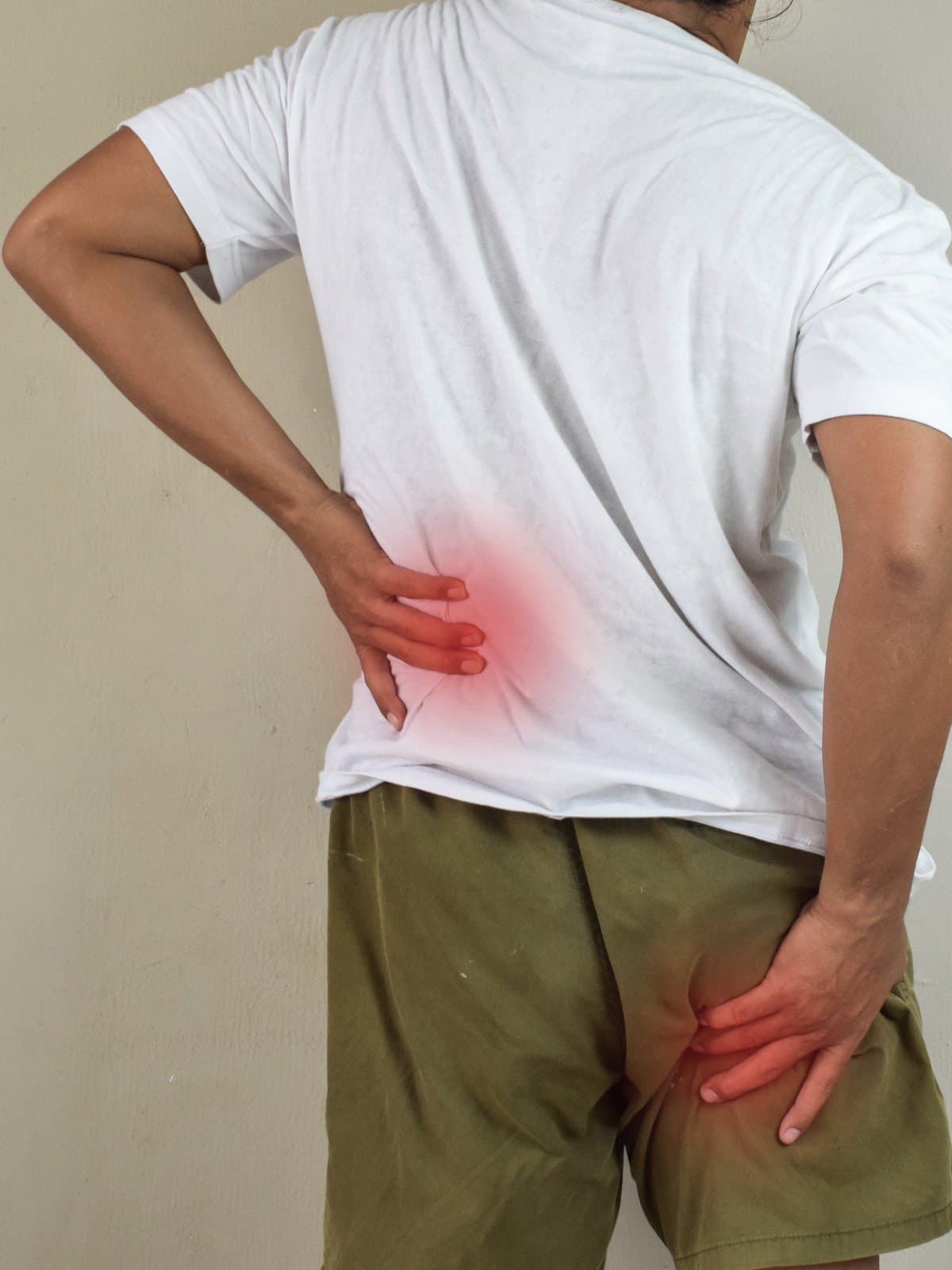
Understanding Radiculopathy and Sciatica
Nerve roots exit the spine at each level and, in the lower back, combine to form the sciatic nerve running down the back of the leg. When a disc herniation or bony narrowing compresses or chemically irritates one of those roots — most often at L4, L5, or S1 — it produces pain, numbness, tingling, or weakness in that specific nerve's distribution, not just at the site of compression.
The pattern is usually distinctive: pain radiating from the low back or buttock down the leg, often past the knee, sometimes into the foot, frequently worse with sitting, bending, or coughing. The specific pattern of numbness, weakness, or reflex change helps pinpoint which nerve root is involved.
Care Pathway
How treatment typically progresses
Start with Conservative Care
Medications
Physical Therapy & Exercise
Mechanical Traction & Decompression
Activity & Behavior Modifications
If Conservative Care Isn't Enough
Epidural Steroid Injections
Regenerative Treatment: Platelet-Rich Plasma (PRP)
Surgical Referral
Many patients never need to reach the interventional step at all — for most acute radiculopathy, conservative care and time are the actual treatment, with injections reserved for those who need more than that.
How We Build Your Plan
The clinical reasoning behind this recommendation
What's the diagnosis?
A history of leg-dominant pain in a specific dermatomal pattern, combined with exam findings — straight leg raise, reflex, strength, and sensation testing — that localize the affected nerve root, correlated with MRI showing a matching disc herniation or foraminal narrowing.
What's the mechanism?
A herniated disc or bony narrowing compresses or chemically irritates a nerve root, producing both mechanical pressure and an inflammatory response that generates pain along that nerve's entire distribution, not just at the point of compression.
What are the options?
Conservative care for most acute cases, since the majority resolve on their own; epidural steroid injections for persistent or severe pain; regenerative treatment for select cases with a significant inflammatory component; and, for progressive weakness or red-flag symptoms, timely surgical referral.
Why this approach?
Because most acute radiculopathy resolves without intervention, Dr. Foster reserves injections and other treatment for patients whose pain is severe enough to significantly interfere with life, or who haven't improved after a reasonable conservative trial — rather than defaulting to a procedure for everyone.
What are the tradeoffs?
Epidural steroid injections are low-risk and can meaningfully speed recovery during the natural healing window, but they calm inflammation around the nerve root rather than 'fixing' the herniation itself. For the small subset with true surgical indications — progressive neurological deficit or cauda equina symptoms — timely referral matters more than working through every injection option first.
Prognosis
One of the more likely conditions here to resolve on its own
This is genuinely good news territory: roughly 60 to 80 percent of patients with acute radiculopathy from a herniated disc improve substantially within 6 to 12 weeks with conservative care alone, as the inflammation settles and the herniated material often shrinks on its own. The outlook does depend somewhat on the cause: radiculopathy from spinal stenosis or significant foraminal narrowing tends to be more chronic, and a small subset of cases — those with progressive weakness or red-flag symptoms — need a faster path to a surgical opinion rather than watchful waiting. But for the great majority of patients, time and the right conservative care are genuinely enough.
Related Treatments
Treatment options for this condition
Sources & Further Reading⌄
- Kögl N, Petr O, Löscher W, Liljenqvist U, Thomé C. "Lumbar Disc Herniation: The Significance of Symptom Duration for the Indication for Surgery." Dtsch Arztebl Int. 2024;121:440-448. This review reports that symptoms resolve in 60 to 80 percent of patients with herniated discs within 6 to 12 weeks with conservative management alone, as inflammation subsides and herniated disc material often partially resorbs over time. View source →
- Directional preference-based exercise (the McKenzie method) has a substantial evidence base for chronic low back pain with a directional preference — in contrast to conditions like facet joint syndrome or SI joint dysfunction, where it's generally less applicable. Note: the most rigorous recent systematic review of this method specifically excludes patients with confirmed radiculopathy, so evidence for the disc-related-radiculopathy population specifically is less clean-cut than for directional-preference low back pain generally.
- Wegner I, Widyahening IS, van Tulder MW, et al. "Traction for low-back pain with or without sciatica." Cochrane Database Syst Rev. 2013;(8):CD003010. This Cochrane review found little to no meaningful benefit from mechanical traction over other treatments, so it's offered selectively — some patients find real benefit from temporarily reducing pressure on the affected nerve root — rather than as a core recommendation. View source →
- Armon C, Narayanaswami P, Potrebic S, et al. "Epidural Steroids for Cervical and Lumbar Radicular Pain and Spinal Stenosis Systematic Review Summary: Report of the AAN Guidelines Subcommittee." Neurology. 2025;104(5):e213361. This current American Academy of Neurology guideline concludes epidural steroid injections probably reduce short-term pain and disability from radiculopathy, with a number needed to treat of roughly 4 to 6 — supportive evidence for short-term relief during the natural healing window, with a more modest effect on long-term outcomes. View source →
Think this might describe your pain?
An accurate diagnosis starts with a conversation. Reach out to schedule a consultation.