
Treatments · Diagnostic & Therapeutic Injections
Peripheral Nerve Blocks
A precise anesthetic injection around a specific peripheral nerve — used both to confirm that nerve as a patient's pain generator and, for some, to provide meaningful short-term relief.
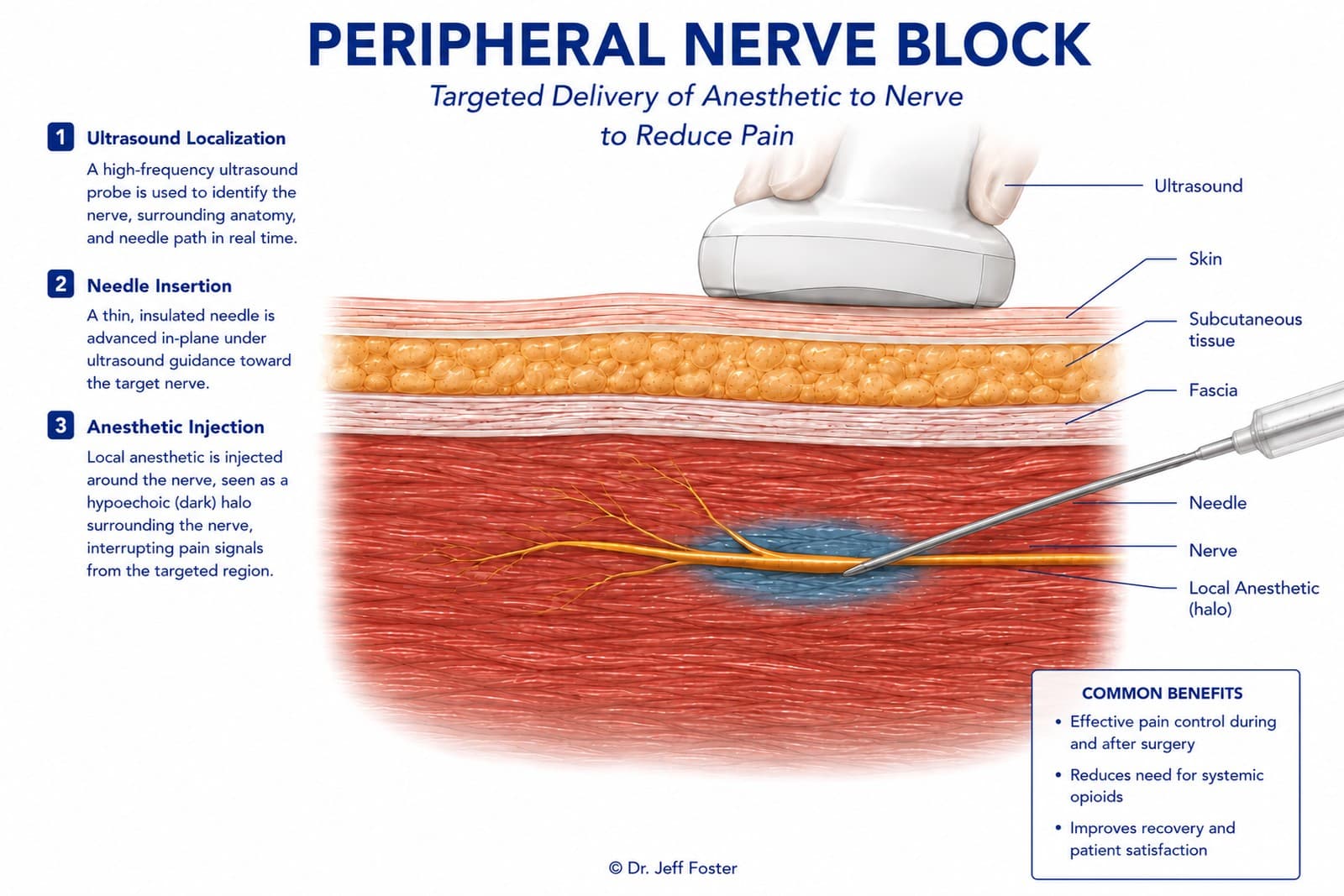
What it involves
A peripheral nerve block delivers local anesthetic — sometimes combined with a small amount of steroid — precisely around a specific nerve suspected of causing a patient's pain. Using ultrasound or fluoroscopic guidance, Dr. Foster positions the needle directly at the target nerve before injecting.
The nerve chosen depends entirely on the pattern and distribution of the patient's pain — from a genicular nerve around the knee, to a suprascapular nerve around the shoulder, to a specific nerve injured during a prior surgery.
How it works
The block temporarily interrupts the target nerve's signaling. If a patient's pain resolves — or improves substantially — in that nerve's distribution while the anesthetic is active, that's strong evidence the nerve is the actual pain generator, not just a bystander.
That information changes the plan directly: a clear, positive response supports moving to a more durable treatment, like peripheral nerve ablation or peripheral nerve stimulation, targeted at the same confirmed nerve.
How We Build Your Plan
The clinical reasoning behind this recommendation
What's the diagnosis?
A specific, suspected peripheral nerve pain generator, based on history, exam, and the pattern and distribution of the patient's pain.
What's the mechanism?
Local anesthetic delivered precisely around the target nerve temporarily interrupts its signaling — if the patient's pain resolves in that nerve's distribution during the anesthetic's effect, that's strong evidence the nerve is the actual pain generator.
What are the options?
A block can be purely diagnostic, therapeutic on its own for some patients, or the first step before a more durable option like peripheral nerve ablation or peripheral nerve stimulation — depending on how the patient responds and how long relief lasts.
Why this approach?
Confirming the specific nerve responsible for a patient's pain — rather than assuming it — changes the entire treatment plan toward something targeted and more likely to work, which is why Dr. Foster uses diagnostic blocks as a deliberate checkpoint before escalating care.
What are the tradeoffs?
Blocks are low-risk and provide valuable diagnostic information, but relief from the anesthetic itself is typically measured in hours, not weeks — so a block alone isn't a long-term solution for most patients; it's the information that guides what comes next.
What to Expect
A quick, low-risk procedure with minimal downtime
The injection itself typically takes about 5 minutes, done under image guidance on an outpatient basis. Patients typically notice numbness in the target nerve's distribution for a few hours as the anesthetic takes effect — the window Dr. Foster and the patient use to track how much the pain actually improves.
There's minimal downtime, and most patients resume normal activity the same day. Because the goal is often diagnostic, the results of the block directly shape the conversation about what treatment comes next.
Trying to pin down a specific source of nerve pain?
An accurate diagnosis starts with a conversation. Reach out to schedule a consultation.