
Conditions · Joint & Structural
Joint Arthritis
Joint arthritis — degenerative or inflammatory — affects the shoulder, hip, knee, or other peripheral joints, and evaluated and treated as part of a broader, function-first approach to joint pain.
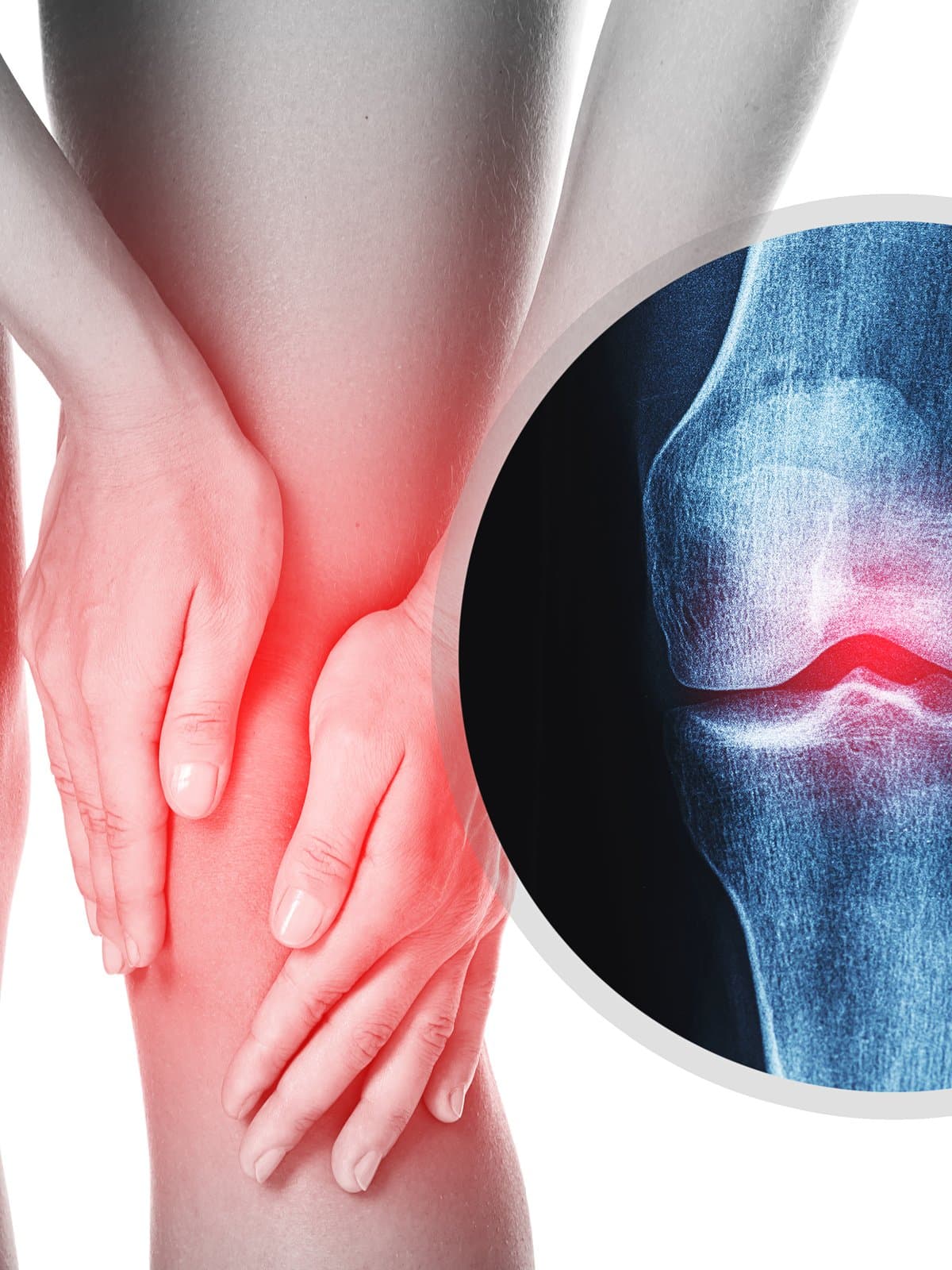
Understanding Joint Arthritis
Osteoarthritis — wear-related cartilage breakdown — is the most common cause of joint arthritis, but inflammatory arthritis (rheumatoid, psoriatic, and related conditions) is a distinct category, usually co-managed with rheumatology. The two patterns look different: osteoarthritis typically causes pain that worsens with activity and brief morning stiffness, while inflammatory arthritis often involves symmetric joints and morning stiffness lasting an hour or more.
X-rays showing joint space narrowing and osteophyte (bone spur) formation support an osteoarthritis diagnosis, while labs and a rheumatology referral come into play when the pattern suggests an inflammatory process instead.
Care Pathway
How treatment typically progresses
Start with Conservative Care
Medications
Physical Therapy & Exercise
Activity & Behavior Modifications
If Conservative Care Isn't Enough
Regenerative Treatment: Platelet-Rich Plasma (PRP)
Genicular Nerve Radiofrequency Ablation
Shoulder Radiofrequency Ablation
Hip Radiofrequency Ablation
Peripheral Nerve Stimulation
Joint Replacement (Surgical Referral)
This progression applies to osteoarthritis. Inflammatory arthritis is primarily rheumatology-led, with interventional pain playing a supporting role alongside disease-modifying treatment rather than driving the primary plan.
How We Build Your Plan
The clinical reasoning behind this recommendation
What's the diagnosis?
A history and exam localized to the affected joint, correlated with X-rays showing joint space narrowing and osteophyte formation for osteoarthritis, with labs and a rheumatology referral when the pattern instead suggests inflammatory arthritis.
What's the mechanism?
In osteoarthritis, cartilage breaks down faster than it's repaired, increasing bone-on-bone friction and triggering inflammation within the joint. Inflammatory arthritis instead involves the immune system attacking joint tissue directly — a fundamentally different process requiring different primary management.
What are the options?
Activity modification and physical therapy, targeted joint injections (corticosteroid or regenerative), joint-specific radiofrequency ablation or peripheral nerve stimulation for patients who respond well to diagnostic blocks but need longer-lasting relief, and referral for joint replacement when structural damage is advanced and less invasive options no longer provide meaningful relief.
Why this approach?
Because osteoarthritis and inflammatory arthritis need different primary treatment approaches, distinguishing them matters before deciding on an interventional plan — treating inflammatory arthritis with only local joint measures would miss the systemic disease actually driving it.
What are the tradeoffs?
Joint injections can provide meaningful, if temporary, relief and help patients delay or avoid surgery, but they don't reverse the underlying joint damage. Radiofrequency ablation and peripheral nerve stimulation extend that relief further for appropriately selected patients, without the invasiveness of surgery. For advanced structural arthritis, joint replacement offers the most complete and durable solution, though it's a bigger surgical step reserved for patients who've exhausted less invasive options.
Prognosis
Chronic, but with a genuinely effective definitive option in reserve
Osteoarthritis is a chronic, generally progressive condition that doesn't reverse — but it's very manageable for a long time with conservative care and injections, and joint replacement is available as a highly effective definitive option when it's eventually needed. It's genuinely one of the more successful surgeries in medicine when the timing is right. Inflammatory arthritis, when properly managed with disease-modifying treatment, can often be controlled well too — though that management is primarily a rheumatology-led process.
Related Treatments
Treatment options for this condition
Platelet-Rich Plasma (PRP)
Learn more →Peripheral Nerve Blocks
A diagnostic block (e.g., genicular, suprascapular) confirms candidacy before radiofrequency ablation.
Learn more →Peripheral Nerve Ablation
Includes genicular nerve RFA for the knee, and joint-specific RFA for the shoulder and hip.
Learn more →Peripheral Nerve Stimulation
Learn more →Sources & Further Reading⌄
- Aletaha D, Neogi T, Silman AJ, et al. "2010 Rheumatoid arthritis classification criteria: an American College of Rheumatology/European League Against Rheumatism collaborative initiative." Ann Rheum Dis. 2010;69(9):1580-1588. These are the current ACR/EULAR classification criteria, superseding the 1987 criteria, and support morning stiffness lasting more than an hour, along with symmetric joint involvement, as a classic pattern suggesting inflammatory arthritis rather than osteoarthritis, which typically causes stiffness that resolves within 30 minutes and pain that worsens with activity. View source →
- Platelet-rich plasma for joint osteoarthritis has a growing evidence base, particularly for knee osteoarthritis, though published systematic reviews and meta-analyses vary in their conclusions, and it's generally considered complementary to, rather than a replacement for, established conservative care.
- Carender CN, Hegde V, Levine BR, Huddleston JI, Cohen-Rosenblum A. "Highlights of the 2024 American Joint Replacement Registry Annual Report." Arthroplasty Today. 2025. This current national registry data — covering more than 4.3 million hip and knee replacements from roughly 5,000 surgeons — continues to reflect a well-established track record of high patient satisfaction and durable pain relief for appropriately selected patients with advanced structural arthritis. View source →
Think this might describe your pain?
An accurate diagnosis starts with a conversation. Reach out to schedule a consultation.