
Treatments · Neuromodulation
Peripheral Nerve Stimulation
A small stimulation lead placed directly along a peripheral nerve to treat focal, well-localized nerve pain — without the need for a spinal-level device.
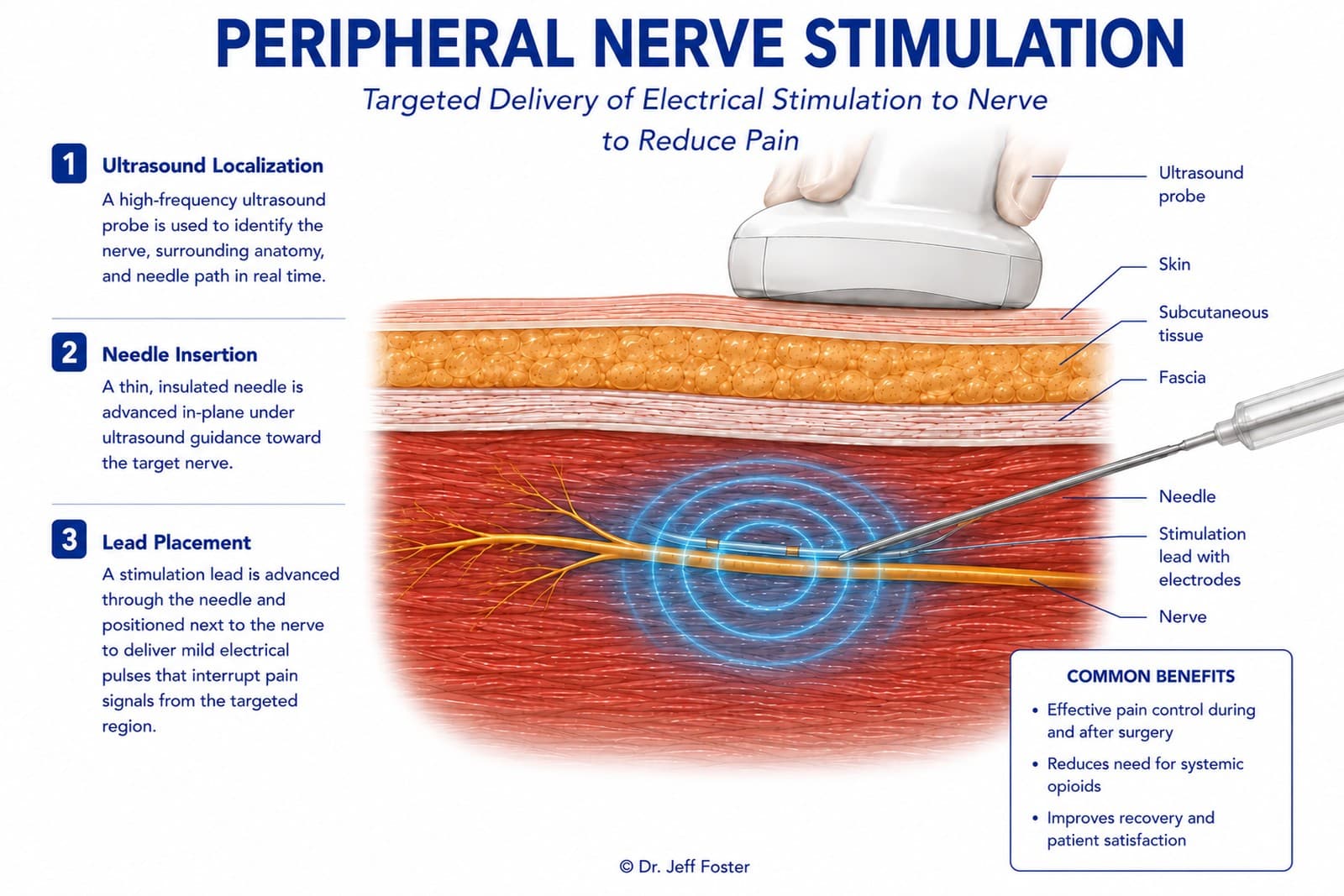
What it involves
Peripheral nerve stimulation (PNS) places a thin lead percutaneously, under image guidance, directly along a specific peripheral nerve outside the spine — the nerve already identified as the pain generator, typically through a prior diagnostic nerve block. The lead connects to a pulse generator, which can be external and temporary or, for longer-term use, fully implanted.
As with other neuromodulation options, many patients start with a trial period using a temporary lead — sometimes a 60-day temporary system on its own — to confirm meaningful relief before deciding whether to move to a permanent implant.
How it works
The lead delivers mild electrical stimulation directly to the affected nerve, interrupting abnormal pain signaling right at its source. Because the stimulation targets the specific nerve involved rather than a broader region of the spinal cord, PNS offers a more focal, matched-to-the-problem option for pain that's confined to one nerve's distribution.
It sits alongside peripheral nerve ablation as a durable option for a confirmed nerve problem — the difference being that PNS modulates the nerve's signaling reversibly, rather than disabling the nerve's ability to transmit pain the way ablation does.
How We Build Your Plan
The clinical reasoning behind this recommendation
What's the diagnosis?
A confirmed, focal peripheral nerve pain generator — often established with a diagnostic nerve block first — in a distribution well-suited to direct nerve-level stimulation rather than spinal-level neuromodulation.
What's the mechanism?
A thin lead placed directly along the affected peripheral nerve delivers mild electrical stimulation that interrupts abnormal pain signaling right at its source, without the need for a spinal-level device.
What are the options?
For a well-localized, focal nerve problem, peripheral nerve stimulation is generally a smaller step than spinal cord or DRG stimulation, and can be considered before or after peripheral nerve ablation depending on how the patient responded to diagnostic blocks.
Why this approach?
When pain is confined to a specific, identifiable nerve, Dr. Foster favors treating that nerve directly — matching the size of the intervention to the size of the problem rather than defaulting to a bigger, spinal-level device.
What are the tradeoffs?
Peripheral nerve stimulation offers reversible, adjustable, longer-term relief without permanently disabling the nerve the way ablation does, but like other neuromodulation options, it typically starts with a trial period and requires an implanted lead and generator.
What to Expect
A trial first, minimally invasive placement
The trial period typically runs one to two weeks with a temporary lead, during which the patient tracks how much relief the stimulation actually provides in daily life. Placement is minimally invasive and done on an outpatient basis, with only mild discomfort at the lead site.
Depending on the product and clinical picture, some patients complete their course of treatment with a temporary 60-day system alone, while others move to a permanent implant. Either way, recovery is measured in days, with activity near the lead site limited briefly to protect its position.
Conditions This Treats
Conditions this treatment addresses
Dealing with focal nerve pain that hasn't responded to other treatment?
An accurate diagnosis starts with a conversation. Reach out to schedule a consultation.