
Treatments · Neuromodulation
Spinal Cord Stimulation (SCS)
An implantable device that delivers mild electrical signals to the spinal cord, interrupting pain signals before they reach the brain — a reversible, adjustable option for chronic pain that hasn't responded to less invasive care.
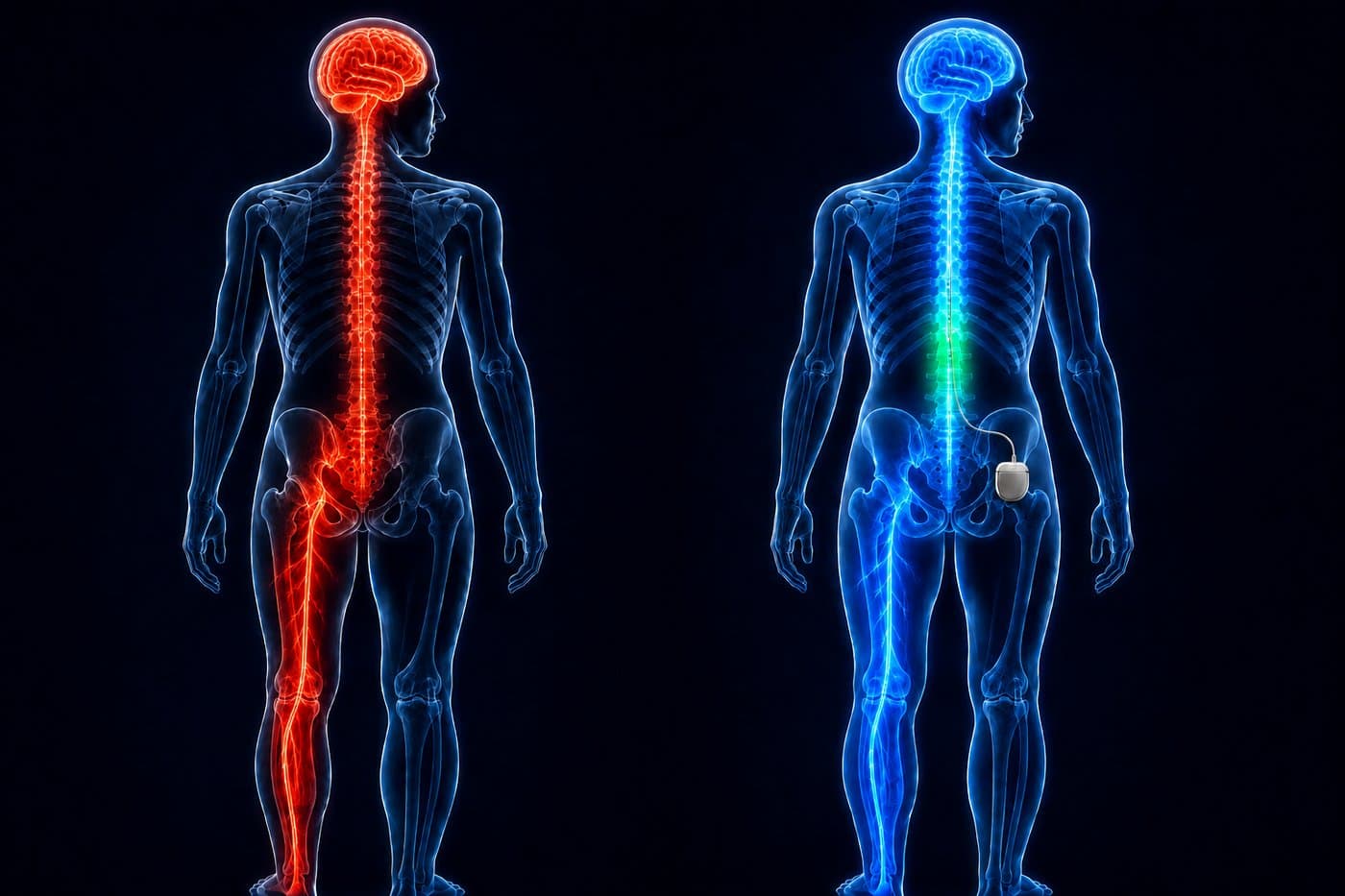
What it involves
Thin leads are placed in the epidural space, along the spinal cord, connected to a small implanted pulse generator that delivers mild electrical signals. Those signals modulate how pain is transmitted before it reaches the brain, and modern systems can do this with or without a perceptible tingling sensation, depending on the programming used.
As with other neuromodulation options, treatment starts with a trial: temporary leads are placed for roughly a week so the patient and Dr. Foster can evaluate how much the device actually reduces pain and improves function in daily life, before committing to a permanent implant.
How it works
By modulating pain signaling at the spinal cord — before it reaches the brain — SCS interrupts the pain pathway broadly across the region covered by the leads, which is why it's well suited to more diffuse pain, such as pain affecting a whole leg or a broader area, rather than a single focal nerve. Its strongest evidence base is specifically in failed back surgery syndrome, though it's also used for CRPS and other refractory neuropathic pain conditions.
Because the system is programmable, settings can be adjusted after implantation as a patient's pain pattern or response changes — and because nothing is destroyed or removed, the device itself can ultimately be removed if it's no longer needed or effective.
Cervical placement for neck and arm pain
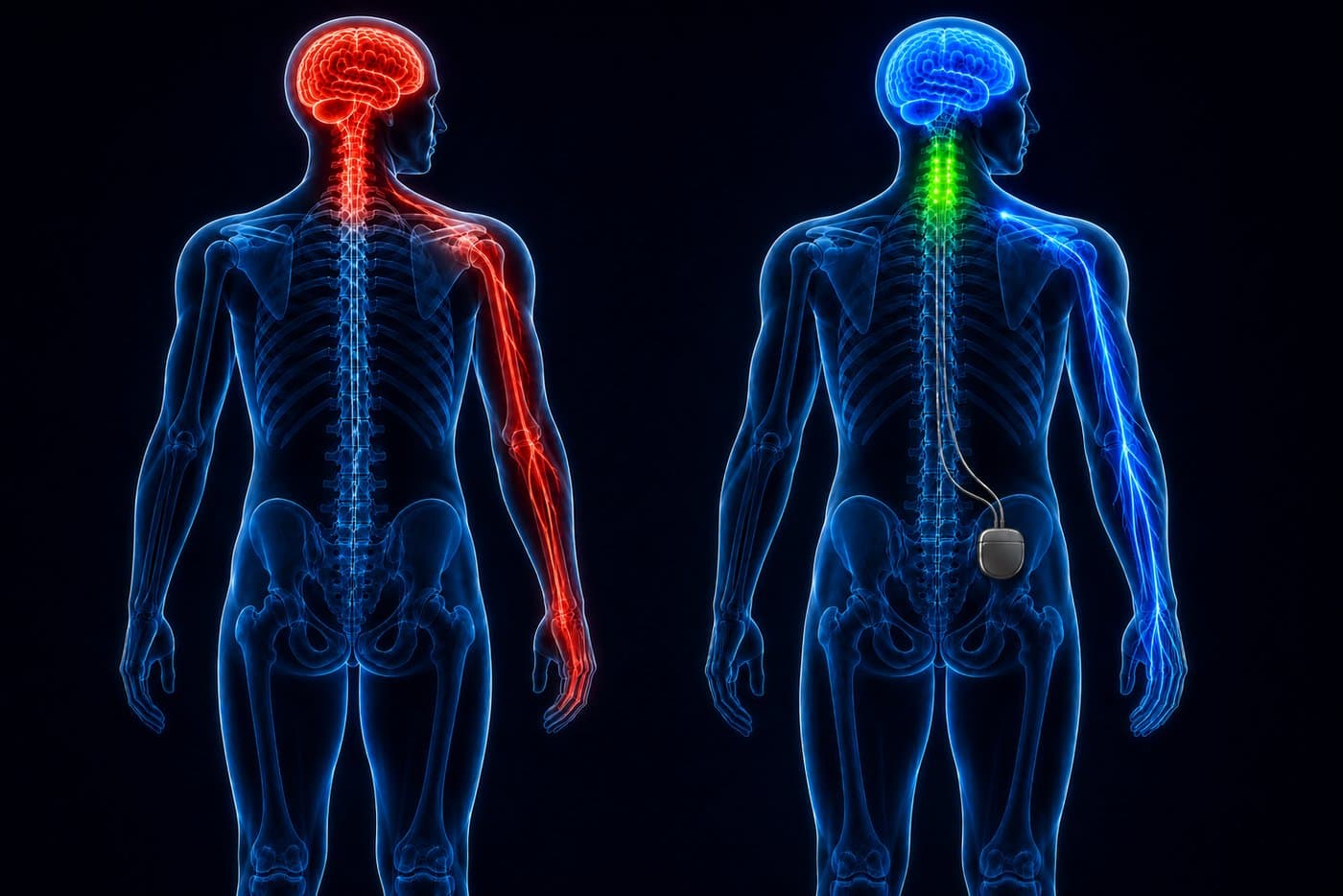
SCS is most often discussed for low back and leg pain, but leads can also be placed at the cervical level to treat chronic neck pain and upper extremity pain — including failed neck surgery that hasn't responded to less invasive care.
The underlying mechanism is identical to lumbar placement — interrupting pain signals before they reach the brain — but the anatomy calls for real technical adjustments. The cervical epidural space is narrower and the spinal cord sits closer to the lamina at these levels, so lead placement demands more precision, and access is typically gained from a lower entry point, with the leads advanced up to the cervical region under careful imaging guidance to keep an adequate safety margin from the cord. As with lumbar and thoracic placement, a trial period with temporary leads comes first to confirm meaningful relief before permanent implantation.
How We Build Your Plan
The clinical reasoning behind this recommendation
What's the diagnosis?
Chronic, refractory pain — most often failed back surgery syndrome, CRPS, or diffuse neuropathic pain — that hasn't responded adequately to conservative care, injections, or more targeted interventional options.
What's the mechanism?
Mild electrical signals delivered to the spinal cord modulate pain transmission before it reaches the brain, broadly interrupting the pain pathway across the region covered by the leads.
What are the options?
A trial period with temporary leads to confirm meaningful relief, followed by permanent implantation for patients who respond well — generally considered after more targeted interventional options haven't provided adequate relief.
Why this approach?
For diffuse or refractory pain that isn't confined to a single identifiable nerve, Dr. Foster considers SCS because it modulates pain signaling more broadly than a focal nerve treatment can, matching the scope of the intervention to the scope of the problem.
What are the tradeoffs?
SCS is reversible and adjustable — a genuine advantage over ablative procedures — but it's a bigger step than an injection, requiring an implanted device and a trial period first. It works best for diffuse pain patterns; a single, well-localized nerve problem is often better matched to peripheral nerve stimulation instead.
What to Expect
A trial first, then a reversible, adjustable implant
The trial phase lasts about a week with temporary external leads, during which the patient tracks real-world pain reduction and function — not just how it feels in the office — since that's what determines candidacy for the permanent system.
Permanent implantation is a short outpatient or short-stay procedure, with recovery typically measured in a few weeks as the lead position stabilizes. Because the system is programmable, follow-up visits fine-tune settings as needed, and the device can be adjusted or, if necessary, removed later.
Conditions This Treats
Conditions this treatment addresses
Sources & Further Reading⌄
- Kumar K, Taylor RS, Jacques L, et al. "Spinal cord stimulation versus conventional medical management for neuropathic pain: a multicentre randomised controlled trial in patients with failed back surgery syndrome." Pain. 2007;132(1-2):179-188 (the PROCESS trial). This pivotal RCT established spinal cord stimulation's evidence base, largely in failed back surgery syndrome patients. View source →
- Kurt E, Noordhof RK, van Dongen R, Vissers K, Henssen D, Engels Y. "Spinal Cord Stimulation in Failed Back Surgery Syndrome: An Integrative Review of Quantitative and Qualitative Studies." Neuromodulation. 2022;25(5):657-670. This more recent integrative review corroborates SCS's continued strong evidence base for this population. View source →
Dealing with chronic pain that hasn't responded to other treatment?
An accurate diagnosis starts with a conversation. Reach out to schedule a consultation.