
Conditions · Spine & Disc
Discogenic Pain
Discogenic pain comes from the intervertebral disc itself — not from a compressed nerve root and not from the facet joints — making it one of the harder pain generators to pin down with confidence.
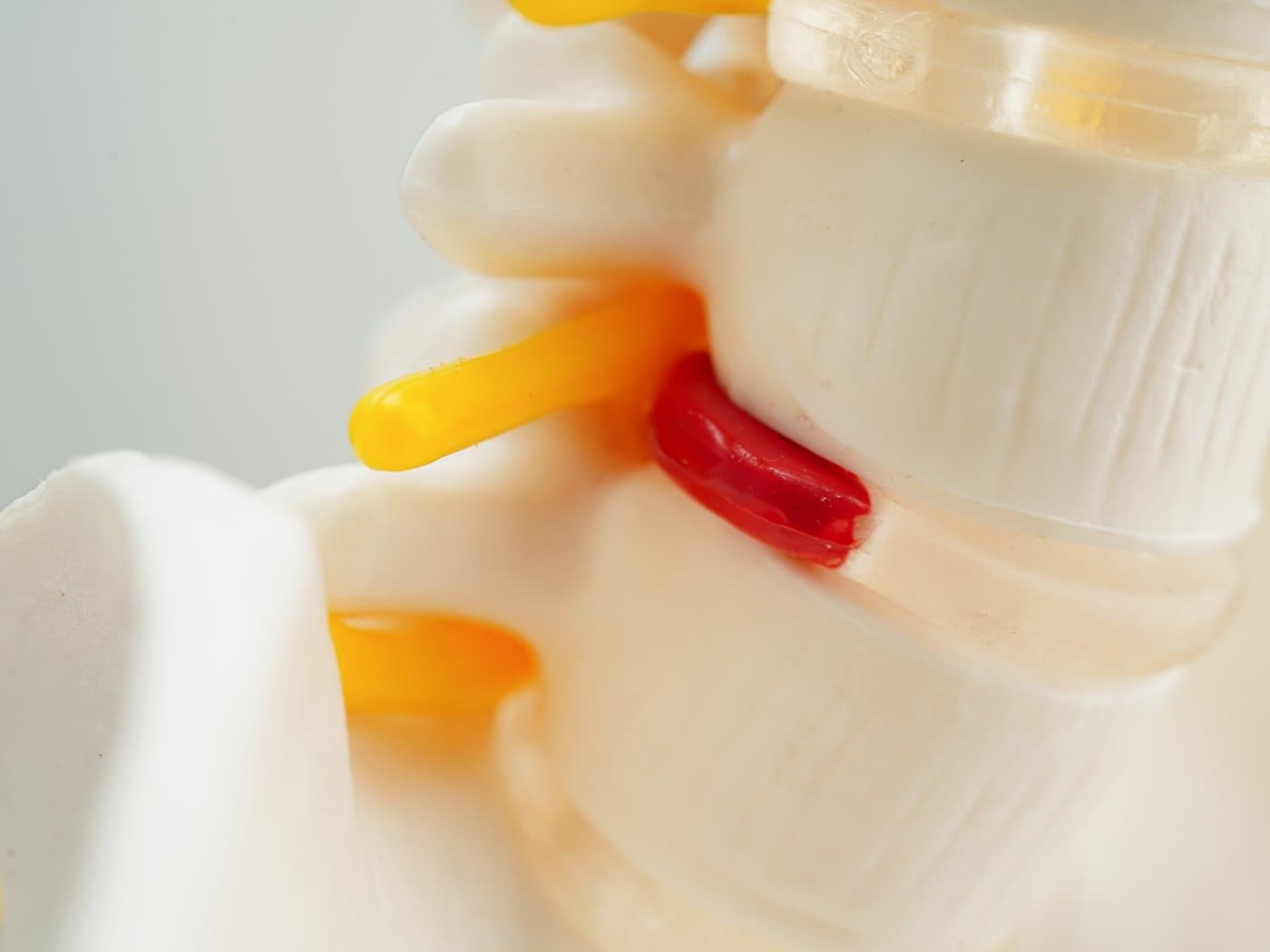
Understanding Discogenic Pain
Each intervertebral disc has a tough outer ring (the annulus fibrosus) surrounding a softer core. When the outer ring develops tears or degenerates, it can grow new nerve fibers into tissue that's normally sparsely innervated, and inflammatory chemicals from the degenerating disc sensitize those nerves — producing pain from mechanical loading of a disc that would normally be silent.
The pattern is typically a deep, central low back ache that worsens with sitting, forward bending, or axial loading of the spine, and eases lying down — distinct from facet pain (worse with extension) and radiculopathy (leg-dominant, following a specific nerve pattern).
Care Pathway
How treatment typically progresses
Start with Conservative Care
Medications
Physical Therapy & Exercise
Mechanical Traction & Decompression
Activity & Behavior Modifications
If Conservative Care Isn't Enough
Diagnostic Anesthetic Discogram
Epidural Steroid Injections
Regenerative Treatment: Platelet-Rich Plasma (PRP)
Regenerative Medicine
Intradiscal Treatments (ViaDisc)
Discogenic pain doesn't have as clean an interventional endpoint as some other back conditions — treatment selection is more individualized, and conservative care deserves a genuinely fair trial before moving toward newer, less-established options.
How We Build Your Plan
The clinical reasoning behind this recommendation
What's the diagnosis?
A history and exam suggestive of disc-origin pain — axial, worsened by sitting and flexion — correlated with MRI findings, with an anesthetic discogram available to directly confirm or rule out a specific disc as the pain generator when the picture remains unclear.
What's the mechanism?
The outer annulus, when torn or degenerated, develops nerve ingrowth and becomes chemically sensitized by inflammatory mediators from the degenerating disc — generating pain from mechanical loading and inflammation, a different mechanism than nerve root compression.
What are the options?
Conservative care as first-line treatment; an anesthetic discogram to confirm the diagnosis when needed; regenerative intradiscal treatment for carefully selected early-stage cases; epidural steroid injections when there's an associated inflammatory or nerve-irritation component; and, for confirmed severe cases that don't respond, a referral for a surgical opinion, which falls outside interventional pain's scope.
Why this approach?
Because disc degeneration on MRI is extremely common even in people with no pain at all, Dr. Foster weighs the specific symptom pattern and response to conservative care heavily, and uses an anesthetic discogram to directly test a specific disc when the diagnosis isn't clear — not every degenerated disc on a scan is actually the pain generator.
What are the tradeoffs?
Regenerative intradiscal treatment is appealing because it targets the disc directly rather than simply masking pain, but the evidence base behind it is newer and narrower than for more established procedures, so candidacy is more selective. Conservative care is genuinely effective for many patients and deserves a fair trial before moving on.
Prognosis
Not always obvious on exam — but a specific diagnosis is possible
The outlook is encouraging: when discogenic pain is tied to a recent disc injury, roughly 60 to 80 percent of episodes improve substantially within 6 to 12 weeks with conservative care alone, the same pattern seen in disc-related sciatica. Longer-standing discogenic pain without a clear recent injury tends to be more variable, but it still responds well for many patients to the right combination of conservative care and, when appropriate, regenerative treatment. Discogenic pain can also be harder to confirm with a physical exam alone than facet joint syndrome or SI joint dysfunction, but it's far from undiagnosable: an anesthetic discogram, which numbs the suspected disc directly, can help confirm or rule it out as the pain generator — much like a diagnostic block confirms other sources of pain elsewhere in the spine.
Related Treatments
Treatment options for this condition
Sources & Further Reading⌄
- Brinjikji W, Luetmer PH, Comstock B, et al. "Systematic Literature Review of Imaging Features of Spinal Degeneration in Asymptomatic Populations." AJNR Am J Neuroradiol. 2015;36(4):811-816. This review found disc degeneration prevalence in pain-free individuals rises from 37% at age 20 to 96% at age 80, which is why correlating imaging with the specific clinical pattern matters more than the scan alone. View source →
- Kögl N, Petr O, Löscher W, Liljenqvist U, Thomé C. "Lumbar Disc Herniation: The Significance of Symptom Duration for the Indication for Surgery." Dtsch Arztebl Int. 2024;121:440-448. For pain associated with an acute disc injury, this review reports symptoms resolve in 60 to 80 percent of patients with herniated discs within 6 to 12 weeks with conservative care alone; chronic, non-acute discogenic pain without a clear inciting injury tends to follow a more variable course, with less clean resolution-rate data specific to it. View source →
- Derby R, Lee JE, Lee SH. "Analgesic discography: effect of adding a local anesthetic to routine lumbar provocation discography." Pain Med. 2010;11(9):1335-1342. An anesthetic (or 'analgesic') discogram — numbing a specific disc under image guidance — is a recognized diagnostic tool for confirming or ruling out that disc as the pain generator, used more selectively than diagnostic blocks elsewhere in the spine given its invasiveness. View source →
- Wegner I, Widyahening IS, van Tulder MW, et al. "Traction for low-back pain with or without sciatica." Cochrane Database Syst Rev. 2013;(8):CD003010. This Cochrane review found little to no meaningful benefit from mechanical traction over other treatments for low back pain, so it's offered selectively — as an option some patients find helpful for temporarily reducing load on the disc — rather than as a core recommendation. View source →
- Azeem N, Myers TJ, Tate JL, Gilmore CA, Harper AS, Block JE. "Supplemental Nucleus Pulposus Allograft in Patients with Lumbar Discogenic Pain: Evaluation of Clinical Outcomes and Quality of Life in Medicare Beneficiaries." Clin Interv Aging. 2025. This early single-arm pilot study is representative of where intradiscal biologic treatment evidence currently stands — a newer and more selectively studied area than established interventions like epidural steroid injections or radiofrequency ablation, with a real but still-developing evidence base. View source →
- Qaseem A, Wilt TJ, McLean RM, Forciea MA. "Noninvasive Treatments for Acute, Subacute, and Chronic Low Back Pain: A Clinical Practice Guideline From the American College of Physicians." Ann Intern Med. 2017;166(7):514-530. This guideline recommends exercise and activity-based care as first-line management for mechanical low back pain, including discogenic presentations. View source →
Think this might describe your pain?
An accurate diagnosis starts with a conversation. Reach out to schedule a consultation.